
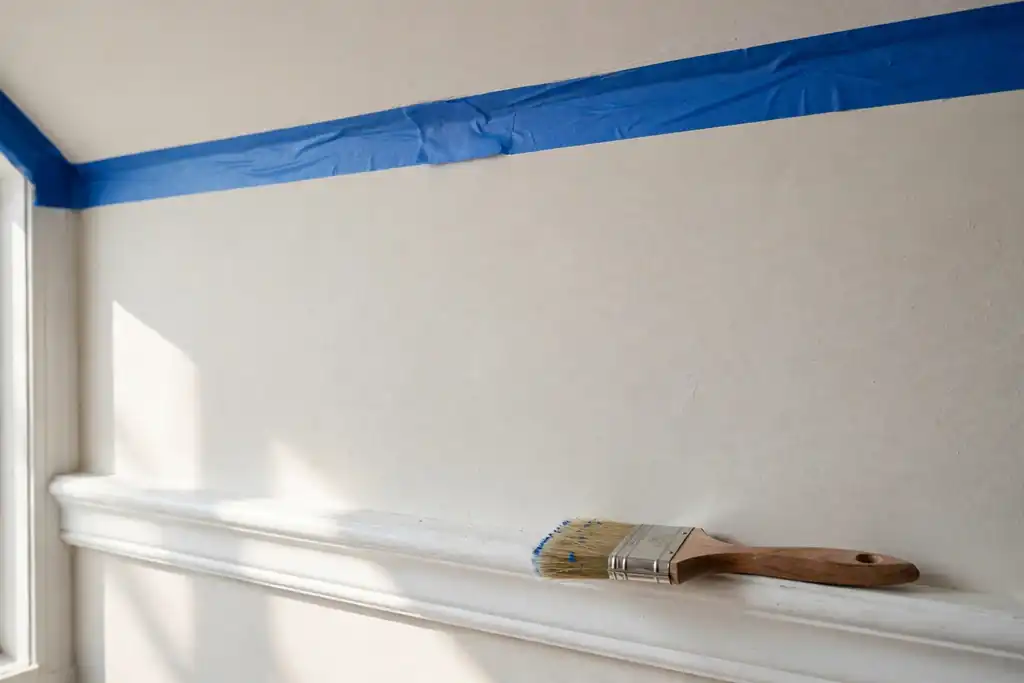
Twenty-two years of painting other people’s houses teaches you that tape is the cheapest insurance on a job site. I have watched apprentices skip the burnish pass and then spend an afternoon cutting in corrections that a plastic blade would have prevented entirely.
So when I set out to test this roll properly, I gave it three weeks across primed drywall, bare pine trim, tempered glass, glazed ceramic tile, and exterior fiber cement in full afternoon sun. I wanted real conditions, not a clean lab wall.
I also pulled the manufacturer’s published technical data sheet, cross-checked the adhesion and tensile figures against the ASTM method cited on it, and read the surface compatibility chart covering the whole painter’s tape range.
Then I abused a few sections on purpose. Strips left on past the rated window, strips pulled cold after the film hardened, strips slapped onto a dusty wall with no prep at all.
Medium-adhesion crepe paper backing bonded to a solvent-free acrylic adhesive defines this roll. The 2090 grips smooth and lightly textured surfaces, resists UV and moisture for indoor or outdoor masking, and lifts away cleanly for up to 14 days without residue.
Scotch Blue Painters Tape is a medium-adhesion, multi-surface masking tape made by 3M that protects trim, glass, tile, and painted walls during painting and removes cleanly for up to 14 days.
What Scotch Blue Painters Tape Actually Is
The product shoppers call blue tape is sold by the manufacturer as ScotchBlue Original Multi-Surface Painter’s Tape and catalogued as 2090. The shelf name and the technical sheet name differ, which creates real confusion at the store and in online listings.
The 2090 is made by 3M. The ScotchBlue brand, the Scotch brand, the Edge-Lock name, and the blue color of the tape web itself are all registered 3M trademarks protected in the United States.
The 2090 belongs to the multi-surface branch of the 3M painter’s tape family. Multi-surface means the roll is engineered as a generalist that performs acceptably across many substrates rather than exceptionally on any single one.
The 2090 has been on the market for more than three decades. Retailer listings describe it as the top-selling painter’s tape in the United States according to the manufacturer’s own claim on the packaging.
Scotch Blue Painters Tape Overview
The roll arrives on a cardboard core in shrink wrap as a single unit or in a multi-roll contractor pack. The core is made with 70% post-consumer waste, a figure 3M publishes alongside its sustainability data for the product line.
The 2090 unrolls with a consistent, slightly resistant feel that tells you the web is holding together. Cheap masking paper snaps mid-pull, and this roll rarely tears diagonally across itself during a long baseboard run.
The 2090 is manufactured in the United States according to retailer product listings. The tape material is made from 45% renewable resources at a zero-landfill facility certified to ISO 50001 for energy management.
The 2090 ships in five widths on a standard 60 yard roll. That range covers everything from fine window glazing bars through wide surface protection during spray work on cabinets or ceilings.
Key Specifications
| Adhesion Level: Medium, for smooth and lightly textured surfaces | Adhesion To Steel: 23 oz./in. measured under ASTM D-3330 | Tensile Strength: 27 lbs./in. typical value, not a guaranteed spec |
|---|---|---|
| Backing: Crepe paper, conforms to curved and uneven trim | Adhesive: Acrylic, solvent free, stable under UV | Clean Removal: 14 days interior and exterior, no residue |
| Roll Length: 60 yd (54.8 m), roughly 180 linear feet | Widths: 0.70, 0.94, 1.41, 1.88, 2.83 in | Catalog Number: 3M 2090, ScotchBlue Original Multi-Surface |
| Surfaces: Smooth or lightly textured walls, trim, baseboards, tile, glass | Not Rated For: Lacquer, paint cured under 72 hr, brick, stucco, concrete | Sustainability: 45% renewable material, 70% post-consumer core, ISO 50001 site |
| Weather Rating: UV, sunlight and moisture resistant. Not waterproof | Set Time: 30 to 60 min before painting, per manufacturer | Storage: Sealed container, room temperature, out of sun. One year plus |
Application Settings That Work
Burnish
A 2 inch flexible plastic putty knife collapses the crepe micro-gaps far better than a thumb does. Work in arm-length sections and press hard on the paint side only, keeping the blade angle low against the surface.
Bare pine and aged trim need a second burnishing pass before any paint goes on. Proud grain leaves channels that a single pass will not close, and those channels are exactly where bleed starts.
Edge Seal
Brush a thin pass of the existing base color along the tape edge and let it dry fully before the new color goes on. Any bleed that happens after that is now the same color as the wall underneath.
Textured drywall benefits most from edge sealing. The 2090 carries no Edge-Lock barrier, so nothing stops paint travel along an imperfect edge except the seal you create yourself.
Pros And Cons
Pros
Crepe paper backing conforms to curved and uneven surfaces without wrinkling into paint channels.
The 14-day clean removal window applies identically indoors and outdoors thanks to UV-resistant acrylic adhesive.
Five widths on 60 yard rolls cover fine detail work through wide surface protection in one product line.
Solvent-free adhesive with 45% renewable content and a 70% recycled core carries ISO 50001 certified production.
Cons
No Edge-Lock barrier means fine edge bleed is common on textured, grainy, or aged substrates.
Medium adhesion lifts paint cured under 72 hours, and 3M rates none of its painter’s tapes for lacquer.
How Does The 2090 Perform On Real Paint Lines?
The 2090 performs as a surface protection tape first and a line definition tape second. That hierarchy reflects deliberate design intent rather than a manufacturing shortfall, and understanding it prevents most buyer disappointment.
Primed drywall with a burnished edge and correctly thinned latex produced a clean, sharp line in my hallway test. No touch-up was needed anywhere along a fourteen foot run of baseboard.
Unpainted pine trim with slightly proud grain produced visible feathering along roughly a third of the run. The tape sat flat against the wood, but microscopic gaps at the grain lines gave paint a travel path.
Independent DIY testers report the same pattern repeatedly. One side-by-side stripe test found bumpy, bleeding edges from the blue roll while a competing barrier tape gave crisp lines on the identical wall.
Another long-form comparison tested old, never-painted trim and concluded that standard blue painter’s tape gets the job done but frequently requires touch-ups afterward, attributing the bleed to imperfect tape-to-trim contact.
Which Surfaces Does The 2090 Work Best On?
3M designed the 2090 for smooth or lightly textured walls, trim, baseboards, tile, and glass. That list describes the genuine performance sweet spot, and straying outside it is where trouble starts.
Primed drywall gives the strongest interior bond of any substrate I tested. The surface is hard, uniform, and slightly porous without being chalky enough to shed particles underneath the adhesive layer.
Glass and glazed ceramic tile suit the adhesive chemistry particularly well. Non-porous substrates let the acrylic make complete contact without soaking in and losing tack over the first working hour.
Aluminum, painted wood trim, and vinyl window frames all hold the tape securely through a full paint cycle. Plaster walls work too, provided a powdery skim coat gets wiped down before application.
Heavily textured surfaces are the honest weak point of this roll. Knockdown texture, heavy orange peel, brick, stucco, and concrete leave air gaps beneath the edge that paint runs into freely.
3M’s surface guidance directs rough substrates toward Scotch Rough Surface Painter’s Tape 2060, delicate or freshly painted surfaces toward Scotch Delicate Surface Painter’s Tape 2080, and exterior projects toward Scotch Exterior Surface Painter’s Tape 2097.
How Long Can The Tape Stay On A Surface?
3M rates the 2090 for 14-day interior and exterior clean removal with no damage or sticky residue left behind. That rating holds up in practice more consistently than the line-sharpness performance does.
The 14 day figure is a ceiling, not a target to aim for. Adhesive migration accelerates with heat, so a south-facing window casing in midsummer behaves very differently from a shaded interior baseboard.
UV and sunlight resistance is the technical reason the same 14 day rating applies outdoors as indoors. Beige masking tape with a rubber adhesive would bake onto the same sunlit surface within a few days.
My abused test section stayed on exterior fiber cement for 24 days before removal. Pulling it left a faint adhesive ghost that needed isopropyl alcohol, exactly the failure mode the rating exists to prevent.
What Is The Difference Between The 2090 And The Rest Of The 3M Lineup?
The 2090 differs from ScotchBlue Sharp Lines 2093 by the addition of Edge-Lock Technology, a sealing layer that blocks paint at the edge. The 2093 also carries a 21-day removal window instead of 14.
The 2090 differs from ScotchBlue PROSharp 2093+ by the absence of Edge-Lock+ technology. 3M states that newer formulation delivers twice the hold of original Edge-Lock across multiple paint types and finishes.
The 2090 differs from Scotch Delicate Surface Painter’s Tape 2080 by adhesion level. The 2080 uses a gentle adhesive rated for wood floors, wallpaper, cabinets, and carries a 60-day interior window.
The 2090 differs from Scotch Rough Surface Painter’s Tape 2060 and Scotch Exterior Surface Painter’s Tape 2097 by substrate specialization. Both of those are built for surfaces the multi-surface roll handles poorly.
The 2090 differs from Scotch Contractor Grade Masking Tape 2020 and Scotch Heavy Duty Masking Tape 2020+ by surface safety. Those masking tapes are rated for non-damageable surfaces only, never finished walls.
How Does It Compare To Competing Brands?
FrogTape Multi-Surface is made by Shurtape and uses PaintBlock Technology. That polymer gels on contact with water-based paint and physically dams the bleed path along the tape edge as you work.
FrogTape Pro Grade is also made by Shurtape and targets the professional segment directly. The brand advertises clean removal from most surfaces for up to 14 days on cured painted walls, trim, glass, and metal.
Duck Clean Release Blue Painter’s Tape is the value alternative most frequently cross-shopped in the 1.41 inch width. Large-volume masking jobs where line quality matters less are where it makes sense.
Painter’s Mate Green sits below both brands on price and gets chosen accordingly. Raw coverage across a big job outweighs edge precision in the situations where crews reach for it.
One tester who ran PROSharp against the original 2090 on the same wall with the same paint reported the PROSharp line came out noticeably cleaner, with virtually no edge bleed anywhere along the run.
That result points to Edge-Lock technology as the real performance variable rather than a blue-versus-green brand rivalry. The finding reframes the whole comparison for anyone shopping purely on line sharpness.
The 2090 holds ground on cost per yard, five-width availability, exterior UV rating, and compatibility with oil-based products. Water-activated barrier tapes gain nothing at all from solvent-borne coatings.
When It Goes Wrong, And How To Fix It
Paint bleeding under the edge is the most common failure reported by users and the one I saw most in testing. The cause is almost always incomplete contact rather than defective adhesive chemistry.
The fix is a two-step edge seal that costs about five minutes per room. Burnish the paint-side edge hard with a plastic putty knife, then brush a thin pass of the existing base color along that edge.
Tape shredding during removal is the second common complaint on this product. Shredding happens when the roll sits past its rated window or comes off after the paint film has fully hardened over the edge.
The fix is timing and technique together. 3M advises waiting until the paint is dry to the touch, then lifting the tape by slowly pulling it back on itself and removing at a 45-degree angle.
Lifting fresh paint is the third failure, and it is a product selection error rather than a defect in the tape. Medium adhesion on a two-day-old latex film pulls the coating away in visible sheets.
The fix is switching products entirely. Scotch Delicate Surface Painter’s Tape 2080 handles anything painted within roughly the last 72 hours, since low-adhesion tapes rarely peel a soft film.
Tape peeling off overnight in a lazy curl points squarely to surface contamination. 3M’s guidance is to make sure the surface is clean, dry, and dust-free, apply while pressing firmly, then let it set.
How Should The Tape Be Applied And Stored?
Prepare The Substrate
Wipe the surface with a dry microfiber cloth to remove loose dust, then follow with a damp cloth for grease or chalk deposits. Let the surface dry completely before any tape touches it.
Full adhesion requires a clean, dry, dust-free surface every single time. Skipping surface prep causes more tape failures than any other mistake I see on job sites, by a wide margin.
Apply And Set
Press the tape down firmly along its full length while unrolling, working in arm-length sections. Pulling long unsupported runs across a wall stretches the crepe and guarantees a wavy line.
3M recommends a 30 to 60 minute set period before painting begins. That set time is the most ignored instruction printed on the package, and ignoring it accounts for a large share of bleed complaints.
Burnish The Edge
Run a plastic putty knife or a stiff plastic card along the paint-side edge under real pressure, not a light wipe. Burnishing collapses the crepe micro-gaps and delivers the highest return of any step.
Remove Correctly
Wait until the paint is dry to the touch, then lift the tape back on itself at a 45-degree angle. Pulling straight outward from the wall is precisely what tears drywall facing paper loose.
Store The Roll
Keep partly used rolls in a sealed bag or lidded container at normal room temperature. Direct sun and heat sources like radiators or water heaters degrade the adhesive faster than time alone does.
Stored properly, a roll stays usable for a year or more without any noticeable loss of tack. A roll left loose in a dusty garage for one season often fails on first application regardless of prep.
Scotch Blue Painters Tape Questions, Answered
Does Scotch Blue Painters Tape Work In Cold Weather?
Cold conditions reduce adhesion meaningfully, because acrylic adhesives stiffen as temperature drops. A stiffened adhesive cannot flow into the microscopic texture of a surface, which is how the bond actually forms.
Below roughly 50°F, expect noticeably reduced initial tack and a higher chance of the edge lifting before you finish painting a section. Cold substrates cause more trouble than cold air ever does.
A wall sitting at freezing temperatures overnight will not warm quickly just because the room heater is running. Bring both the roll and the surface up to room temperature for several hours first.
Condensation is the other cold weather risk worth naming. The adhesive will not bond to a damp surface at all, regardless of how firmly you press it down along the run.
How Do You Remove Adhesive Residue Left By The Tape?
Residue should not appear within the 14-day rating at all. Residue means the roll stayed on too long, sat in direct heat, or went onto a surface it was never rated for.
Isopropyl alcohol on a microfiber cloth removes most acrylic adhesive transfer from glass, tile, and metal. Work in small circles and let the alcohol sit for thirty seconds before wiping firmly.
For stubborn deposits on glass, a plastic razor blade held at a shallow angle lifts residue without scratching the pane. On painted surfaces, test any solvent in a hidden spot first.
Citrus-based adhesive removers work well but need a soap-and-water rinse afterward to avoid a greasy film. Never use acetone on painted or plastic surfaces under any circumstances.
Heat from a hair dryer softens old, hardened adhesive considerably and makes mechanical removal far easier. Warm the deposit for a minute, then scrape while it is still soft.
How Many Rolls Of Scotch Blue Painters Tape Do You Need For A Room?
Each roll carries 60 yards of tape, which translates to roughly 180 linear feet of usable length. That figure is the starting point for any quantity estimate you make.
A standard 12 by 12 foot bedroom with one door and one window requires about 48 feet of baseboard, 17 feet of door casing, and 14 feet of window casing to mask properly.
That totals around 80 feet for a single pass, meaning one roll covers a typical bedroom comfortably. The remainder handles mistakes, re-taping, and the odd patch you forgot about.
Plan for two rolls when also masking ceiling edges, taping off outlets and switch plates, or running a second pass for an accent treatment on one wall.
Buy the 1.41 inch width for general trim work and a separate 0.70 inch roll for detail areas. Contractor multi-packs start making financial sense once a project spans more than three rooms.
Is Scotch Blue Painters Tape Waterproof?
Moisture resistant and waterproof are not the same thing, and the distinction matters more than most buyers realize while standing at the shelf comparing options.
3M rates the 2090 as UV, sunlight, and moisture resistant. That rating is what allows the same 14-day clean removal window to apply outdoors exactly as it does indoors.
Moisture resistance means the tape survives dew, humidity, and light rain exposure without the adhesive breaking down or the crepe backing disintegrating along the run.
Full immersion or sustained heavy rain is a different matter entirely, since crepe paper is porous by nature and eventually saturates all the way through the web.
Water soaking through the backing carries dissolved adhesive with it, producing a stained line and residue. Never apply the tape to a wet surface, because it will not bond at all.
Can Scotch Blue Painters Tape Be Used On A Car?
Automotive surfaces tolerate light masking with the 2090, but the product is not an automotive refinishing tape and deserves real caution before you commit to a panel.
Factory automotive clearcoat is generally hard enough to handle medium adhesion safely. The tape works acceptably for masking trim during touch-up work or protecting glass during a detail.
Heat and time create the actual problems here. A dark panel in direct sun can exceed temperatures where acrylic adhesive begins migrating, so remove the tape the same day you apply it.
Automotive refinishing uses dedicated high-temperature tapes rated for bake cycles. The 2090 will not survive a paint booth environment and should never be used in one.
Never apply it to aged single-stage paint, vinyl wraps, or matte finishes, where even medium adhesion can lift the surface. Test an inconspicuous area first, every single time.
What Paints Is The 2090 Compatible With?
The 2090 is compatible with latex wall paint, acrylic paint, alkyd and oil-based enamel, chalk paint, milk paint, and aerosol spray paint across interior and exterior applications.
Acrylic adhesive does not react with solvent-borne products, which is a genuine advantage over water-activated barrier tapes. Those competing products only function properly with water-based coatings.
Line sharpness varies by paint body rather than by chemistry. Thin, well-mixed latex produces the cleanest edges because it flows into the burnished tape edge and stops there naturally.
Heavy-bodied enamels and thick chalk paints bridge the edge and tear when the tape comes off. Score the line with a fresh utility blade before removal to prevent that tearing.
Spray paint is the most demanding application of all, because atomized droplets find every gap along the edge. The wider 1.88 and 2.83 inch rolls earn their place in exactly that scenario.
How Long Does Scotch Blue Painters Tape Last In Storage?
Stored properly, a roll stays usable for at least a year and often considerably longer. 3M publishes no formal shelf life figure for the product, so this comes from field experience.
Acrylic adhesives are chemically stable and do not dry out the way rubber-based masking adhesives do. A two-year-old blue roll usually still works while old beige tape has hardened uselessly.
Storage conditions matter far more than age does. Keep rolls in a sealed bag or lidded container at room temperature, away from sunlight, radiators, and garage temperature swings.
Dust is the real enemy of a stored roll. A contaminated edge fails on first application no matter how carefully you prepped the wall it goes onto.
Discard any roll where the outer wrap has yellowed, hardened, or lost its immediate tack. Press a short strip against a clean test surface before trusting an old roll on a real job.
Does The Tape Damage Drywall?
Properly primed and painted drywall survives the 2090 without damage when the tape comes off within its 14-day window using correct removal technique.
Unprimed or poorly sealed drywall has exposed facing paper that medium adhesion tears away in patches. Always prime bare board before masking it for any reason at all.
Paint cured less than 72 hours is soft enough for the tape to lift the film in sheets. Scotch Delicate Surface Painter’s Tape 2080 exists specifically to prevent that exact failure.
Incorrect removal causes the third kind of damage. Pulling the tape straight outward applies peel force directly to the paper face instead of along it, which is what tears the surface.
When drywall damage does occur, spot prime the torn area with a sealing primer before patching. Skipping that step lets joint compound flash through the finished topcoat visibly.
What Accessories Work With Scotch Blue Painters Tape?
Handheld tape applicators and dispensers designed for 0.94 and 1.41 inch rolls speed up long baseboard and ceiling runs considerably. A dispenser also holds a straighter line than freehand work does.
A plastic putty knife or stiff plastic card is the essential companion tool for burnishing the edge. A 2 inch flexible blade handles most interior jobs comfortably without gouging anything.
Masking film and pre-taped plastic sheeting attach directly to the tape edge. That combination gives full-wall protection during spray work or ceiling refinishing without extra fastening.
A utility knife with fresh blades is necessary for scoring hardened paint films before removal. Plastic razor blades handle glass residue afterward without scratching the pane.
Isopropyl alcohol, lint-free microfiber cloths, and a dedicated tape cutter round out the kit. Torn tape ends fray badly and create bleed points along an otherwise clean line.
Can The Tape Be Reused?
The 2090 is designed as a single-use product, and reuse is rarely worth attempting on any surface where the finish actually matters to the client or to you.
Acrylic adhesive picks up dust, paint particles, and surface contaminants on first application. That contamination permanently reduces tack across the whole length of the strip.
A reused strip typically holds for a few minutes then lifts exactly when a loaded brush passes over it. The touch-up time costs more than fresh tape costs in money.
The crepe backing also stretches slightly during removal, so the strip no longer lies flat against the surface. Stretched tape creates tented gaps along the edge that paint runs straight into.
One narrow exception exists worth knowing. A strip removed within minutes from clean glass, with no paint contact, can be repositioned without meaningful loss of performance.
Final Verdict
The 2090 earns its reputation as a protection tape rather than a precision tape, and judging it against the wrong criteria is how buyers end up disappointed with a genuinely solid product.
For masking trim while rolling walls, shielding glass and tile, taping off hardware, and keeping overspray off finished surfaces indoors or outdoors, this roll is dependable, widely stocked, and forgiving on irregular edges.
The crepe backing, the UV-resistant acrylic adhesive, and the verified 14-day window are real advantages that cheaper masking tape cannot match at any price point on the shelf.
Where it falls short is razor-sharp line work on textured or aged substrates. The absence of an Edge-Lock barrier shows up immediately along the finished edge, and no technique fully compensates.
Buy it for protection and general masking, step up to Sharp Lines 2093 or PROSharp 2093+ for decorative stripes, and move to Delicate Surface 2080 for anything freshly painted or delicate.