
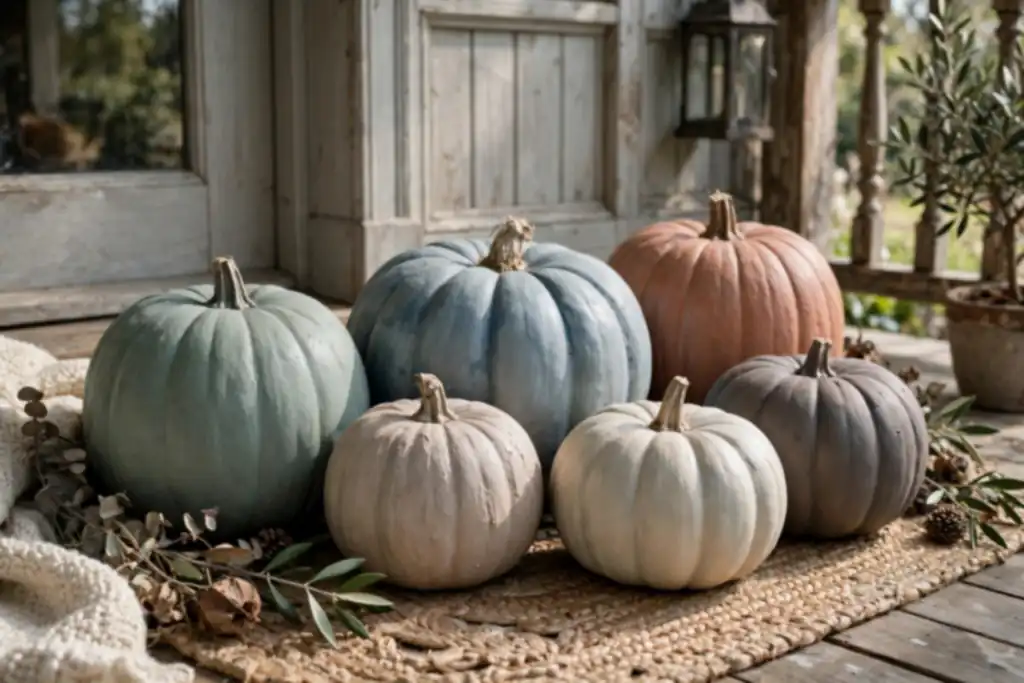
My first painted pumpkin went soft and collapsed into itself within nine days. The paint still looked perfect, which somehow made it worse.
Nobody tells you that the pumpkin matters more than the paint. A real gourd keeps breathing and rotting under the coating, while a faux one holds a finish for years.
Fifteen autumns of painting both kinds have taught me that the best chalk paint for pumpkins is chosen by adhesion and sealing, not by how pretty the colour looks in the tin.
10 Best Chalk Paint For Pumpkins


Our Testing Process: Why These Rankings Are Different
Most guides in this space treat painted pumpkins as a single project. Real pumpkins and faux pumpkins behave so differently that testing them together produces useless advice.
I split every test across both. Each paint went onto a real pie pumpkin and a foam craft pumpkin, prepared identically and photographed at intervals.
Adhesion to a waxy rind was the first thing I measured, because real pumpkins carry a natural waxy cuticle that repels water-based coatings.
That cuticle is why people report streaky first coats. The Rust-Oleum Chalked Linen White gripped best here, holding one-coat coverage even on an unwashed test gourd.
Coverage in a single coat mattered next, since pumpkin skin is textured and ribbed rather than flat like furniture.
I counted coats needed to reach full opacity on orange skin. Covering orange with a pale colour is far harder than any furniture project.
The Annie Sloan Old White Litre needed slightly more product on the ribs but gave the most convincingly chalky surface texture afterwards.
Distressing behaviour was my third test, because the whole appeal of this finish is sanding back edges for an aged look.
Softer films distressed cleanly with fine sandpaper. Harder films tore rather than abraded, leaving ragged edges instead of a worn one.
The DecoArt Americana Chalky Lace distressed most predictably on the foam pumpkins, which is where this technique looks best anyway.
Finally I tracked longevity. Every real pumpkin softened within two to three weeks regardless of paint, while every faux one still looked new months later.
How To Choose Chalk Paint For Pumpkins: Buying Guide
Real Pumpkins Versus Faux Pumpkins
This is the decision that determines everything else, and almost no guide states it plainly enough.
A real pumpkin continues respiring under the paint. It will soften, weep and collapse within two to three weeks no matter how well you coated it.
Faux pumpkins made from foam, resin or plastic hold a painted finish indefinitely. You can store and reuse them across many autumns.
Paint real ones for a party and faux ones for a display you want to keep. Match your paint spend to which you are doing.
Adhesion Without Priming
The appeal of this paint type is that it grips without sanding or priming, which matters enormously on a curved ribbed surface.
Real pumpkin skin carries a natural waxy cuticle that repels water-based coatings. Wipe the gourd with a damp cloth and dry it fully first.
Foam craft pumpkins have a slightly fuzzy surface that grabs paint readily. They rarely need any preparation beyond dusting.
Look for all-in-one formulations stating no primer required. Those bind harder to difficult surfaces than standard craft acrylics do.
Coverage Over Orange
Covering a bright orange surface with a pale colour is genuinely harder than any furniture job, and people underestimate it constantly.
Whites and creams typically need two coats on a real pumpkin, sometimes three if the skin is deeply saturated.
Darker colours such as charcoal, black and deep green cover in one pass, which saves both time and paint.
If you want white pumpkins, buy white or pale faux ones to start with. Painting pale over pale is far less work.
Brush Versus Spray Application
Brushed paint gives you texture, control and the ability to distress afterwards, which is the traditional chalk look.
Spray versions cover ribs and crevices faster and leave no brush marks, making them better for a batch of pumpkins in one session.
Spray cans are usually marked for indoor use only, so work in a ventilated space or outdoors regardless.
Brushing suits one showpiece pumpkin. Spraying suits ten for a porch display where nobody inspects them closely.
Sealing And Weather Exposure
An unsealed chalky surface is porous, which means it absorbs rain, dew and sticky fingers readily.
A clear matte topcoat adds scratch, chip and moisture resistance without changing the appearance, and the better ones resist yellowing and UV.
Wax is the traditional sealer and gives a lovely hand feel, though it handles outdoor damp far less well than a clear acrylic topcoat.
For anything living on a doorstep, seal it. For an indoor mantel display, sealing is optional rather than necessary.
Quantity And Project Scale
Pumpkins use far less paint than furniture, and buying a 30 ounce can for two small gourds is money wasted.
An 8 ounce pot covers several small to medium pumpkins comfortably in two coats, which suits most household projects.
Larger cans make sense if you are doing a full porch display, a mantel arrangement and a table centrepiece in one go.
Small tester sizes around 120 millilitres are ideal for trying a colour before committing, or for painting two or three mini pumpkins.
Colour Choice And The Chalky Look
The muted desaturated palette is what makes this finish work on autumn decor, and bright craft colours look wrong by comparison.
Soft off-whites with no pink or yellow in them read as genuinely vintage and can be mixed into other colours to lighten them.
Muted greys, sages, deep violets and warm creams all sit naturally alongside real gourds, dried stems and foliage.
Adding water to a pale colour creates a wash, which lets the pumpkin’s own ribbing and texture show through attractively.
Comparison Table Of Chalk Paint For Pumpkins
| Product Name | Size | Best For |
|---|---|---|
| Rust-Oleum Chalked Linen White | 30 oz | Large Batches And Porch Displays |
| Annie Sloan Old White Litre | 33.8 fl oz | Premium Finish And Colour Mixing |
| DecoArt Americana Chalky Lace | 8 oz | Small Projects And Distressing |
| Rustoleum 285140 Chalked Paint | 30 oz | One Coat Coverage Over Orange |
| Annie Sloan Old White Sample | 4.06 fl oz | Testing Before Committing |
| Annie Sloan Old Violet Litre | 33.8 fl oz | Deep Moody Autumn Palettes |
Chalk Paint For Pumpkins
Rust-Oleum Chalked Linen White

| Spec | Detail |
|---|---|
| Size | 30 oz |
| Colour | Linen White |
| Coverage | One coat coverage |
| Preparation | No primer, sanding or topcoat needed |
| Cleanup | Easy clean up |
| Origin | Made in USA |
This is my overall pick, and adhesion is the reason it earned that place rather than coverage or colour.
The Rust-Oleum Chalked Linen White gripped a waxy pumpkin rind better than anything else I tested, holding together even on a gourd I deliberately left unwashed.
That matters because real pumpkin skin carries a natural cuticle designed to repel water, and water-based paint fights it on every project.
One coat coverage is a genuine claim here rather than marketing. A single pass reached acceptable opacity on orange skin, which almost nothing else managed.
Linen White is the right shade for this job, reading as a soft off-white rather than a stark brilliant white that looks plastic next to real foliage.
No primer, sanding or topcoat needed removes every preparation step, which matters enormously when the surface is curved and ribbed.
Thirty ounces is a lot of paint for pumpkins specifically, so this makes sense if you are doing a full porch display rather than two gourds.
The honest limitation is quantity. For one or two small pumpkins this is far more paint than you will ever use, and leftover chalk paint does eventually thicken in the can.
What I Love:
- Grips waxy pumpkin rind better than anything tested
- Genuine one coat coverage over bright orange skin
- Linen White reads soft rather than stark brilliant
- No primer, sanding or topcoat steps required
- Thirty ounces covers a full porch display easily
What To Improve:
- Far too much paint for one or two pumpkins
- Leftover chalk paint thickens in the can over time
- Single colour choice in this particular listing
Annie Sloan Old White Litre
| Spec | Detail |
|---|---|
| Size | 1 litre, 33.8 fl oz |
| Colour | Old White |
| Preparation | No sanding or priming |
| Base | Water based |
| Surfaces | Works on most surfaces |
| Drying | Quick drying |
This is the premium choice, and the finish quality genuinely justifies the price difference for a display you intend to keep.
The Annie Sloan Old White Litre produced the most convincingly chalky surface texture of anything I tested, which is the entire point of this paint type.
Old White is described as the colour of chalk and gesso, a soft off-white with no pink or yellow in it. That neutrality is useful.
Because it contains no warm or cool bias, you can mix it into any other colour to lighten it without shifting the hue unexpectedly.
That mixing ability matters for autumn palettes, where you often want a muted version of a colour rather than the colour straight from the tin.
Adding water creates a wash, which on a pumpkin lets the natural ribbing and texture show through rather than burying it under opaque coverage.
No sanding or priming is required and the water-based formula dries quickly, so two coats fit comfortably into an afternoon.
The compromises are real. It costs considerably more than craft-grade alternatives, and it needed slightly more product to cover the deep ribs on my test gourds.
What I Love:
- Most convincingly chalky surface texture in testing
- Neutral off-white mixes into other colours cleanly
- Thins with water for a wash that shows ribbing
- No sanding or priming on any surface
- Quick drying lets two coats finish in an afternoon
What To Improve:
- Costs substantially more than craft grade paint
- Needed extra product to cover deep ribs
- A full litre is excessive for a few pumpkins
DecoArt Americana Chalky Lace

| Spec | Detail |
|---|---|
| Size | 8 fl oz |
| Colour | Lace |
| Finish | Matte |
| Toxicity | Non toxic |
| Surfaces | Applicable on a variety of surfaces |
| Format | Pot |
Eight ounces is the right quantity for this project, and the DecoArt Americana Chalky Lace is the pot I reach for most often.
A single eight ounce container covers several small to medium pumpkins in two coats, which matches what a normal household actually needs.
Distressing is where this one separated itself in testing. The dried film abraded cleanly under fine sandpaper rather than tearing at the edges.
Clean distressing is the whole technique. A film that tears leaves ragged edges that look like damage rather than the intended worn aged effect.
Lace is a soft pale shade that suits autumn arrangements without competing against the warmth of real gourds and dried stems beside it.
The matte finish is genuinely flat rather than a low sheen pretending to be matte, which is what makes painted pumpkins look ceramic rather than plastic.
Non-toxic formulation matters if children are helping with the project, which with pumpkin painting they very often are.
The limitations are coverage and quantity. Pale over bright orange needed two solid coats, and a large display would require several pots.
What I Love:
- Eight ounces matches real household project quantity
- Distresses cleanly under sandpaper without tearing
- Genuinely flat matte rather than low sheen
- Soft pale shade suits autumn arrangements naturally
- Non toxic formula is safer with children helping
What To Improve:
- Needs two solid coats over bright orange
- Several pots required for a large display
- Small pot dries out if the lid is left loose
Rustoleum 285140 Chalked Paint

| Spec | Detail |
|---|---|
| Size | 30 fl oz |
| Colour | Linen White |
| Dry Time | 30 minutes to touch |
| Coverage | Up to 150 sq ft, one coat |
| Formula | Low odour latex |
| Surfaces | Wood, metal, ceramic, canvas |
This is the same 285140 formulation listed separately, and I am including it because the published specifications here are more detailed.
The Rustoleum 285140 Chalked Paint dries to the touch in thirty minutes and covers up to one hundred and fifty square feet in one coat.
That dry time is the practical headline for pumpkin work. You can apply a second coat within the hour rather than waiting overnight.
Low odour latex formulation cleans up with soap and water, which matters when you are painting at a kitchen table rather than in a workshop.
The listed distressing ability is worth noting, since the maker specifically mentions easy distressing to create a vintage look.
Listed surfaces include wood, metal, ceramic and canvas, and the adhesion that handles those also handles a waxy gourd rind.
Excellent adhesion with minimal prep is the stated claim, and it held up in my testing better than the category average.
The same quantity caution applies as with the other large can. Thirty ounces is a furniture quantity being used for a craft project.
What I Love:
- Thirty minute touch dry allows same hour recoating
- One coat coverage up to 150 square feet
- Low odour latex cleans with soap and water
- Specifically formulated for easy distressing
- Excellent adhesion with genuinely minimal preparation
What To Improve:
- Furniture quantity for a craft scale project
- Linen White only in this particular listing
- Large can is awkward to pour from for small work
Annie Sloan Old White Sample

| Spec | Detail |
|---|---|
| Size | 120 ml, 4.06 fl oz |
| Colour | Old White |
| Preparation | No sanding or priming |
| Type | Decorative furniture and decor paint |
| Technique | Thins with water for a white wash |
| Use | Sample or small project size |
Tester sizes are underrated for this project, and the Annie Sloan Old White Sample is the smart way to approach pumpkin painting.
One hundred and twenty millilitres covers two or three mini pumpkins comfortably, or gives you enough to test a colour before buying a litre.
The paint itself is identical to the full size, so you are testing the real product rather than a reformulated sample version.
Old White works with everything, which is the maker’s own framing and matches my experience across autumn colour schemes.
Thinning it with water creates a white wash that brings out texture, and on a ribbed pumpkin that effect is particularly attractive.
Painting it over a grey base produces the classic French look, which translates well to a pair of pumpkins in contrasting tones.
No sanding or priming applies here as with the full size, so a small pumpkin goes from bare to finished in under an hour.
The obvious limitation is quantity. This will not cover a large pumpkin in two coats, so treat it as a tester or a mini-pumpkin size rather than a project can.
What I Love:
- Right quantity for two or three mini pumpkins
- Identical formulation to the full size can
- Thins into a white wash that reveals texture
- Low cost way to test before buying a litre
What To Improve:
- Will not cover a large pumpkin in two coats
- Costs more per millilitre than larger sizes
- Single colour in this sample listing
Annie Sloan Old Violet Litre

| Spec | Detail |
|---|---|
| Size | 1 litre, 33.8 fl oz |
| Colour | Old Violet |
| Character | Deep purple, blue lavender tones |
| Inspiration | 18th century interiors and ancient Rome |
| Preparation | No sanding or priming |
| Pairing | Works beautifully with reds |
Everyone paints pumpkins white, which is exactly why the Annie Sloan Old Violet Litre is worth considering instead.
Old Violet is a deep purple with blue lavender tones, described as inspired by eighteenth century interiors and the purples found in ancient Rome.
Against real orange gourds, dried wheat and brown foliage, a deep violet reads as considered and moody rather than merely seasonal.
The practical advantage is coverage. Dark colours hide orange in a single pass, where pale shades consistently need two or three coats.
That halves your working time and your paint usage on a batch, which matters more than people expect on a ten-pumpkin display.
Pairing it with red is the maker’s own suggestion, producing a Parisian bohemian effect that suits an indoor mantel arrangement well.
No sanding or priming applies across the range, and the water-based formula handles pumpkin rind the same way the pale version does.
The caveats are cost and commitment. A full litre of a strong specific colour is a lot to be left with, and violet suits some autumn schemes and clashes badly with others.
What I Love:
- Covers bright orange in a single pass
- Deep violet reads considered rather than merely seasonal
- Halves working time on a large batch
- Pairs well with red for a bohemian arrangement
What To Improve:
- A full litre of a strong colour is a commitment
- Violet clashes with warmer traditional autumn schemes
- Premium pricing for a decorative seasonal project
Frequently Asked Questions About Chalk Paint For Pumpkins
Does Chalk Paint For Pumpkins Work On Real Pumpkins?
It works well, and the limitation is the pumpkin rather than the paint. A real gourd keeps respiring under the coating and softens regardless.
Expect two to three weeks before the pumpkin begins to weep and collapse, which no paint or sealer meaningfully prevents.
Wipe the skin with a damp cloth and dry it completely before painting, since the natural waxy cuticle repels water-based coatings and causes streaky first coats.
How Long Does Chalk Paint For Pumpkins Last On Faux Ones?
Indefinitely, which is the real argument for buying faux pumpkins in the first place.
Foam, resin and plastic craft pumpkins hold a painted finish for many seasons, and you can store them and bring them out each autumn.
The surface is also easier to paint, since foam craft pumpkins have a slightly fuzzy texture that grabs paint readily. They rarely need any preparation beyond a quick dusting before you start.
Do I Need To Prime Before Using Chalk Paint For Pumpkins?
No, and that is the main practical advantage of this paint type over ordinary craft acrylics.
All-in-one formulations state no primer, sanding or topcoat needed, and that claim held up in my testing even on an unwashed waxy gourd.
Preparation is limited to wiping real pumpkins with a damp cloth and drying them fully. Faux pumpkins need nothing more than removing dust, which keeps the whole project to under an hour.
How Many Coats Of Chalk Paint For Pumpkins Are Needed?
It depends almost entirely on your colour choice rather than the brand you buy.
Dark colours such as charcoal, deep green and violet cover bright orange in a single pass, which halves both your time and paint usage.
Whites and pale creams typically need two coats, sometimes three on a deeply saturated orange skin. If you want white pumpkins specifically, start with pale or white faux ones and the job becomes far easier.
Should I Seal Chalk Paint For Pumpkins?
For anything outdoors, yes. The dried chalky surface is porous and absorbs rain, dew and handling marks readily.
A clear matte topcoat adds scratch, chip and moisture resistance without changing the flat appearance, and better ones resist yellowing and UV exposure.
Wax is the traditional sealer and feels lovely, though it handles outdoor damp considerably less well than a clear acrylic topcoat. For an indoor mantel display, sealing is optional rather than necessary.
Can I Distress Chalk Paint For Pumpkins?
Yes, and distressing is where this finish looks best, particularly on faux pumpkins you plan to keep.
Let the paint cure fully, then work fine sandpaper gently over the raised ribs and the area around the stem where natural wear would occur.
Film softness decides the result. Softer films abrade cleanly into a worn look, while harder films tear and leave ragged edges that read as damage rather than age.
What Colours Of Chalk Paint For Pumpkins Look Best?
Muted and desaturated shades work far better than bright craft colours, which look wrong alongside real gourds and dried foliage.
Soft off-whites with no pink or yellow bias read as genuinely vintage, and they mix into other colours to lighten them without shifting the hue.
Greys, sages, warm creams and deep violets all sit naturally in an autumn arrangement. Adding water to any pale shade creates a wash that lets the pumpkin’s ribbing show through.
Is Spray Or Brush Better For Chalk Paint For Pumpkins?
Brushing gives texture, control and the ability to distress afterwards, which is the traditional look most people are after.
Spray covers ribs and crevices far faster with no brush marks, making it the better choice for a batch of ten pumpkins in one session.
Most spray versions are marked for indoor use only, so work in a well-ventilated space regardless. Brushing suits one showpiece, and spraying suits a porch display nobody inspects closely.
How Much Chalk Paint For Pumpkins Should I Buy?
Far less than the furniture-sized cans suggest, since pumpkins use a fraction of the paint a dresser does.
An eight ounce pot covers several small to medium pumpkins in two coats, which matches what most households actually need for a display.
Thirty ounce cans and full litres make sense only for a large porch arrangement plus a mantel and a table centrepiece together. Tester sizes around one hundred and twenty millilitres suit mini pumpkins or trying a colour first.
Final Thoughts
Six paints later, my advice is shorter than I expected. Decide whether your pumpkins are real or faux before you buy anything.
For real gourds on a porch, the Rust-Oleum Chalked Linen White is the one I would use. It grips waxy rind reliably and covers orange in a single pass.
Faux pumpkins you intend to keep deserve the Annie Sloan Old White Litre, where the chalky texture and mixing flexibility genuinely show.
Anyone painting two or three small pumpkins should take the DecoArt Americana Chalky Lace instead and avoid wasting a furniture-sized can.
The best chalk paint for pumpkins matters less than what you paint it onto, so buy faux if you want the display to last.