
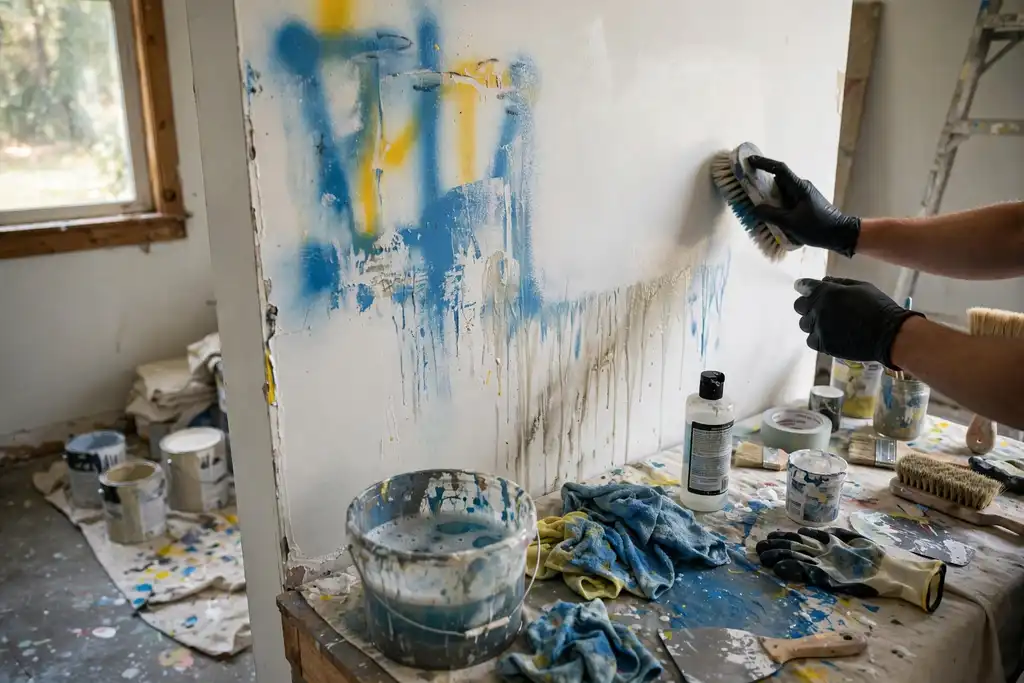

Match the solvent to the wall and test a hidden spot first: harsh chemicals can soften drywall paper, etch paint, or stain drywall, so a mild approach done right beats a fast one that ruins the surface.
What is the safest way to lift overspray without turning a small blemish into a repair job? Learning how to get spray paint off wall surfaces starts with identifying what the wall is made of and how long the paint has cured, because fresh overspray wipes up with denatured alcohol while hardened coats need more persuasion.
You will get a surface-by-surface plan for drywall, plaster, brick, and concrete, plus the mistakes that cause the most damage: soaking drywall, gouging plaster with a scraper, or blasting brick with a pressure washer. Safety comes first, so expect guidance on ventilation, skin protection, and solvent choices before you touch the wall.
- Identify the wall material first; drywall, plaster, brick, and concrete each need different methods.
- Test any solvent, paint thinner, or acetone on a hidden spot before full application.
- Scrape gently and sand with fine sandpaper; aggressive sanding damages drywall paper.
- Ventilate the room and wear gloves and eye protection with solvents.
- Skip pressure washers indoors; they destroy drywall and spray contaminants.
How to Get Spray Paint off Wall: the Quick Decision Before You Start
Before you touch a rag or a scraper, make one decision: what the wall is made of and what the coating is sitting on. Get that wrong and you will trade a spray paint stain for a repair job. The table below gets you to the right method fast.
| Your situation | What to do | Why |
|---|---|---|
| Wall is sealed or painted drywall | Start with the mildest solvent, spot test first | Drywall paper and paint react badly to strong chemicals |
| Wall is bare plaster | Use a solvent, then a scraper | Plaster is porous and holds residue |
| Wall is brick or concrete | Mechanical or pressure methods | Masonry tolerates scrubbing and water |
| Paint looks fresh, still tacky | Wipe with denatured alcohol now | Fresh spray paint lifts far easier |
| Paint is fully cured and hard | Soften first, then scrape | Dry paint chips and smears |
| Unsure how the wall reacts | Test a hidden spot for 24 hours | Solvents can stain or soften finishes |
| Indoor job, poor airflow | Ventilate or move to a safer method | Solvent fumes build up fast |
Recommended for this job

Max Strip Spray Paint & Graffiti Remover
Fast-acting gel clings to walls and lifts spray paint from brick, wood, metal and concrete.

Smart 'n Easy Paint & Varnish Remover
Gel remover strips multiple layers of spray paint and varnish from wall surfaces.

ThxToms Chemical Resistant Nitrile Gloves
Chemical-resistant gloves protect hands while applying solvent to remove spray paint from walls.
Start by identifying the wall surface type. Drywall, plaster, brick, and concrete each tolerate different chemicals and pressure, and what saves one ruins another.
What Type of Wall Are You Dealing with?
Know the substrate before you buy anything. Drywall has a paper face that solvents can lift, while brick and concrete take scrubbing and water without complaint.
How Thick is the Spray Paint Layer?
Thin overspray comes off with a light solvent wipe. Heavy coats need softening and a scraper, because sanding thick paint clogs sandpaper, the abrasive material used for smoothing softer materials, in seconds.
Is the Spray Paint Fresh or Dried?
Fresh, tacky spray paint wipes off with denatured alcohol. Cured paint needs a solvent or heat gun to soften it first.
Do You Need a Chemical, Mechanical, or Heat Method?
Test the spray paint for solvent sensitivity on a hidden patch, then pick your method. Chemicals suit flat painted walls, scrapers and sandpaper suit masonry, and a heat gun softens cured coats without thinner.
5-Minute Diagnostic: Checks Before Any Work
How to Identify Your Wall Surface (Drywall, Plaster, Brick, Concrete, Painted)
Press a thumb into the wall: drywall gives slightly, plaster stays hard, and brick or concrete feels gritty. Scratch a hidden corner with a putty knife to confirm.
How to Test Spray Paint for Solvent Sensitivity
Swab denatured alcohol on one spot and acetone on another, wait 60 seconds, then check for softening. Stop if the wall paint lifts or chalks.
How to Assess Paint Thickness and Adhesion
Slide a plastic scraper under an edge: thin overspray flakes in 1 to 2 minutes, while thick coats resist. Score a 1-inch square with a utility knife and lift it to gauge bond strength.
Is the Area Well-Ventilated?
Set a box fan blowing outward in a window and open a second window for cross-flow. Keep solvent, paint thinner, and acetone fumes below OSHA exposure limits by ventilating the full session.
Paint thinner is a solvent that dissolves and softens cured spray paint so it can be wiped or scraped off the wall.
Run these quick checks before you touch a rag or a scraper, because the wrong first move can cost you the wall surface.
How Spray Paint Removal Works: Chemical, Mechanical, and Heat Methods
Chemical Solvents: How They Break Down Paint
A solvent softens cured film so you can lift it without gouging the wall. Match product to paint: acetone or paint thinner for most aerosols, denatured alcohol for some formulations. Test a hidden spot first.
- Ventilate and wear gloves and eye protection.
- Apply solvent to a rag, not the wall; dab a small area.
- Let sit 1 to 5 minutes, then wipe with a clean rag.
- Repeat in small sections; rinse residue with water.
Mechanical Scraping and Sanding: When They Work Best
Best on smooth, sound surfaces where paint sits on top rather than soaked in. Use a sharp, angled scraper, then finish with sandpaper. Keep pressure light on drywall and plaster to avoid tearing paper or gouging compound. On brick and concrete, a wire brush speeds things up.
Heat Gun Method: Softening Thick Paint
Softens thick, built-up coats so a scraper peels them in strips. Keep the nozzle moving, 6 to 8 inches from the wall. Stop if the surface smokes or drywall paper browns. Never use near flammable solvents or on surfaces just cleaned with paint thinner.
Pressure Washing: for Exterior Walls Only
Blasts loosened paint off brick and concrete fast, but destroys drywall and damages plaster. Reserve for exterior masonry. Start at a low setting, keep the wand moving, and work top to bottom so runoff does not streak clean areas.
Before You Start: Tools, Materials, and Safety Gear
Protect lungs and eyes first, solvent and paint thinner fumes build fast in closed rooms. Open two windows for cross-flow and add an outward-blowing fan. Keep a fire extinguisher nearby if using a heat gun.
Safety Gear and Ventilation Specifics
Wear nitrile gloves, sealed goggles, and an organic-vapor respirator (not a dust mask). Set up cross-ventilation before opening solvents; never work near a pilot light or water heater. Keep kids and pets out until surfaces are dry.
Tools and Products You’ll Need
Gather a plastic scraper, sandpaper, rags, and a drop cloth. Match product to surface: solvent or acetone for cured spray paint on concrete or brick, denatured alcohol for plaster, heat gun or pressure washer for exteriors.
Eco-Friendly and low-VOC Remover Options
Choose low-VOC or citrus-based removers indoors or where airflow is poor. They work slower, 30 minutes to hours per coat, so allow extra dwell time. Test on a hidden patch first.
Legal and Safety Considerations for Graffiti Removal
Confirm ownership or written permission before removing anything, especially on shared or public structures. Check local solvent disposal rules; many require hazardous waste drop-off. On older walls, test for lead paint before sanding.
- Ventilation first: open two windows for cross-flow and add a fan blowing outward before opening any solvent or paint thinner.
- Respirator, not a dust mask: use a cartridge rated for organic vapors, plus nitrile gloves and sealed goggles.
- Fire risk: keep flames and pilot lights away from solvent fumes, and store a fire extinguisher nearby if using a heat gun.
- Match product to surface: solvent or acetone for concrete and brick, denatured alcohol for plaster, heat gun or pressure washer for exterior walls.
- Basic kit: plastic scraper, sandpaper, rags, and a drop cloth to catch residue and protect flooring.
- Green options: low-VOC or citrus removers suit indoor rooms but need 30 minutes to a few hours of dwell time per coat.
- Permission and disposal: get written approval for shared walls and check municipal rules for hazardous waste drop-off.
- Lead check: test older walls before sanding, since lead paint may sit under the spray paint.
Step-by-Step: How to Get Spray Paint off Wall (Chemical Solvent Method)
Step 1: Protect the Area and Put on Safety Gear
Open two windows and run a box fan pulling air outward before you open any solvent. Wear nitrile gloves (not latex), splash goggles, and a respirator with organic vapor cartridges rated by OSHA for solvent work. Tape 0.7 mil plastic drop cloths over floors and outlets within 10 feet of the wall.
Step 2: Test a Small Area with Solvent
Choose a 6 inch square near the floor and rub on a dime-sized amount of paint thinner with a rag. Wait 1 to 5 minutes, then press a plastic scraper against it. If the spray paint wrinkles but the wall finish stays intact, proceed; if the drywall paper fuzzes or paint dulls, switch to denatured alcohol.
Step 3: Apply Solvent and Let It Dwell
Work in 2 square foot sections, brushing on acetone or paint thinner with a natural-bristle brush. Let it sit 1 to 5 minutes, checking every minute so it does not evaporate before lifting. Reapply rather than flooding, which can soak drywall paper.
Step 4: Scrape or Wipe Away Softened Paint
Drag a plastic scraper at a 30 degree angle on drywall or plaster, or scrub brick and concrete with a stiff nylon brush. Wipe residue with a rag before it rehardens, usually within 5 minutes.
Step 5: Rinse and Neutralize the Surface
Wipe the wall with a damp cloth and 1 teaspoon mild dish soap per quart of water to pull solvent residue. Let it dry 24 hours, then sand remaining flecks with 220-grit sandpaper (an abrasive material for smoothing surfaces) before repainting.
Work through these steps in order, and let the solvent do the work instead of your elbow.
Alternative Paths: Mechanical, Heat, and Pressure Washing (Plus Follow-Up Care)
When a solvent won’t cut it, these mechanical and heat-based paths work, provided you protect the surface and yourself first. Put on safety glasses, an organic-vapor respirator, and nitrile gloves before scraping or sanding.
Mechanical Scraping and Sanding Steps
Scrape the softened film with a plastic scraper held at a shallow angle, checking every few strokes. Then sand stubborn patches with 120-grit sandpaper, finishing with 220-grit on painted surfaces.
Heat Gun Method for Thick Paint
Warm thick paint with a heat gun kept moving 6 to 8 inches from the wall, keeping the nozzle moving to avoid scorching.
Pressure Washing for Exterior Walls
Pressure wash exterior brick or concrete at 1,500 to 2,000 psi with a 25-degree tip.
Dealing with Drywall Damage After Removal
Cut out blistered drywall with a utility knife and patch with joint compound.
Removing Spray Paint from Brick and Concrete
Test a hidden spot on brick with a stiff brush and masonry cleaner before full application.
When a solvent won't cut it, these mechanical and heat-based paths work, provided you protect the surface and yourself first.
Troubleshooting: When the Paint Won't Budge or the Wall Gets Damaged
When a patch of spray paint refuses to lift or the wall starts coming apart, stop and diagnose before you make it worse. Most failures trace to the wrong solvent, too much dwell time, or too much muscle.
| Problem | Likely cause | Fix |
|---|---|---|
| Paint won't soften | Wrong solvent for the coating | Test acetone, denatured alcohol, or paint thinner on a hidden spot |
| Solvent flashes off too fast | Warm room or thin coat | Reapply and cover with plastic briefly |
| Drywall paper tearing | Scraper digging into face paper | Switch to a plastic scraper and light passes |
| Gouges in drywall | Sandpaper too coarse or pressure too hard | Use finer grit, feather edges, then patch |
| Underlying paint lifting | Solvent too strong for base coat | Switch to denatured alcohol and shorter dwell |
| Brick or concrete holds paint | Porous surface gripped the pigment | Try a pressure washer on a low setting |
| Ghosting after removal | Residue soaked into the surface | Scrub with denatured alcohol, let dry, seal |
Paint Won’t Soften with Solvent?
Your solvent likely does not match the coating. Test acetone, denatured alcohol, and paint thinner on a hidden spot, and give each a few minutes to work.
Drywall Paper Tearing or Gouging?
Switch to a plastic scraper and light passes. Sandpaper is abrasive material for smoothing surfaces, so keep grit fine and pressure low, then feather edges and patch.
Solvent Damaging the Underlying Paint?
Step down to denatured alcohol and shorten dwell time. Wipe, do not soak, and stop as soon as the spray paint lifts.
Residue or Ghosting After Removal?
Scrub the wall with denatured alcohol to pull residue, let it dry fully, then seal before repainting.
Quick Checklist: Before You Start or Decide
Wall Type Identified?
Know what you’re scrubbing before you touch it. Drywall and plaster gouge easily, while brick and concrete tolerate stiffer scraping and washing.
Solvent Sensitivity Tested?
Test any solvent on a hidden spot first. Apply paint thinner, acetone, or denatured alcohol to a small area and watch for softening, discoloration, or lifted finish.
Safety Gear and Ventilation Ready?
Solvents put fumes in the air fast. Open windows, add a fan, and wear nitrile gloves, eye protection, and a respirator rated for organic vapors.
Removal Method Chosen?
Match the method to the surface and paint thickness. A scraper or sandpaper suits cured overspray, while a heat gun or chemical stripper handles heavier coats.
Waste Disposal in Place?
Used solvent, rags, and paint residue are household hazardous waste in most areas. Check your local disposal rules before you start.
- Wall type: Confirm whether the surface is drywall, brick, or concrete before choosing a method.
- Spot test: Apply solvent to a hidden patch and check for damage after a few minutes.
- Ventilation: Open windows and set up a fan before opening any solvent.
- Safety gear: Wear nitrile gloves, eye protection, and an organic vapor respirator.
- Method: Pick scraping, sanding, heat, or chemical stripping based on paint thickness.
- Disposal: Line up hazardous waste drop-off for solvent-soaked rags and residue.
How Weather, Season, and Climate Change the Answer
Indoor vs Outdoor Removal: Ventilation and Temperature
Indoors, use cross-ventilation and an organic-vapor respirator; open windows, run a fan outward, and keep fumes from pilot lights. Outdoors, work on a calm day at 60-80°F.
Humidity and Solvent Evaporation
High humidity slows evaporation, so acetone and denatured alcohol linger and soften coatings unevenly, allow more dwell time and wipe residue before it re-sticks. Low humidity speeds drying, making solvents act too fast.
Cold Weather and Heat Gun Use
Below about 50°F, solvents weaken and heat-gun softening slows. Warm walls gradually, keep the nozzle moving to avoid scorching drywall or cracking plaster, and never use a heat gun near flammable residue.
Pressure Washing in Freezing Temperatures
Skip pressure washing near freezing, as water can freeze on brick or concrete and trap moisture. Above 40°F, use a wide fan tip and test a hidden patch first.
Cost: DIY vs Professional Spray Paint Removal
Typical DIY spray paint removal runs $30 to $150 in materials, while professional removal often costs $200 to $800 depending on wall size and paint type. Your real savings come from avoiding surface damage that turns a small fix into a drywall repair.
| Option | Upfront cost | Ongoing cost | Notes |
|---|---|---|---|
| DIY solvent and thinner | $15 to $60 | Reapply as needed | Match solvent to paint type |
| DIY safety gear | $20 to $50 | Replace filters periodically | N95 respirator, goggles, gloves |
| DIY tools | $10 to $40 | Blades and sandpaper wear out | Scraper, sandpaper, heat gun |
| DIY total | $30 to $150 | Minor consumables | Assumes small to medium area |
| Pro chemical removal | $200 to $500 | None | Interior drywall or plaster |
| Pro pressure washing | $250 to $800 | None | Exterior brick or concrete |
| Pro drywall repair | $100 to $400 | None | If DIY damage occurs |
Costs are typical US ranges for a 10 to 50 square foot area as of 2025. Professional quotes vary by region, access, and paint type. Times assume one person working carefully.
Most homeowners spend $30 to $150 on DIY supplies, or $200 to $800 for professional removal. Budget 1 to 3 hours for small DIY jobs, or 2 to 4 hours for a pro crew.
DIY Cost Breakdown (Solvents, Tools, Safety Gear)
Expect $30 to $150 total for solvent, a scraper, sandpaper, and safety gear. Solvent choice depends on the paint: acetone or denatured alcohol for fresh spray paint, paint thinner for cured coats.
Professional Removal Estimates
Pros typically charge $200 to $500 for interior chemical removal and $250 to $800 for exterior pressure washing. Get two written quotes and confirm they include cleanup and disposal.
Time and Effort Estimates
Plan 1 to 3 hours for small DIY spots and 2 to 4 hours for a professional crew. Drying and curing time adds 24 hours before you can repaint.
To repaint means applying a fresh coat of paint over the cleaned and dried wall to restore its original finish.
Tips to Avoid Costly Damage
Test any solvent on a hidden spot first. Stop scraping if you see drywall paper tearing, and never mix solvents. Proper ventilation and an organic-vapor respirator protect your health and your walls.
Common Mistakes to Avoid When Removing Spray Paint
Rushing prep and cleanup, rather than the product itself, causes most damage during spray paint removal. Avoid these five errors to protect the wall and yourself.
Skipping the Solvent Test
Test a hidden spot first: apply paint thinner, wait a few minutes, and confirm the coating softens without damaging the wall finish.
Using Too Much Solvent or Not Enough Ventilation
More solvent isn’t faster. Work in small sections, open windows, and wear gloves plus an organic-vapor respirator (OSHA), since acetone and denatured alcohol fumes build up fast.
Scraping Too Aggressively on Drywall
Drywall paper tears easily. Hold the scraper at a shallow angle and let softened coating lift; use fine sandpaper only after the bulk is gone.
Not Neutralizing or Rinsing Properly
Residue can soften fresh paint or stain plaster and concrete. Wipe with a damp cloth, rinse, and dry fully before priming.
Ignoring Local Regulations for Graffiti Removal
Many cities require permits or specific disposal methods. Check municipal rules and EPA solvent-disposal guidelines, especially for exterior brick or concrete.
- Test a hidden spot: apply paint thinner to an inconspicuous area and confirm it softens the spray paint without damaging the wall finish.
- Ventilate and limit solvent: work small sections with open windows and a respirator rated for organic vapors, since acetone and denatured alcohol fumes concentrate quickly.
- Scrape gently on drywall: keep the scraper at a shallow angle to avoid tearing the paper face, then finish with fine sandpaper.
- Rinse all residue: wipe with a damp cloth and let the wall dry completely before priming, or fresh paint may fail.
- Check local rules: confirm permit and disposal requirements for graffiti removal and solvent waste with your municipality or the EPA before starting.
When to Call a Pro: Real Warning Signs
Large Areas or High Ceilings
If the paint covers more than a small patch or sits above comfortable reach, stop. Large areas on high walls mean ladders, scaffolding, and long solvent exposure, which is a pro’s job. A pro can also tell you whether repainting or encapsulating beats stripping.
Toxic Fumes or Confined Spaces
Call a professional when the wall is in a closed room with poor airflow. Solvents, paint thinner, and acetone build up fast indoors, and OSHA treats those vapors as a real health hazard. Pros bring ventilation and respirators rated for the job.
Structural Damage or Delicate Surfaces
Stop if the wall is crumbling, soft, or already flaking. A scraper, sandpaper, or heat gun can turn minor damage into a repair bill on old plaster or damaged drywall. Get a pro to assess before you touch it.
Legal or Safety Concerns
Check the rules before you clean graffiti from public or shared property. Some cities require permits or licensed removal, and pressure washing brick or concrete can damage mortar and spread runoff. When in doubt, hire a licensed contractor.
Stop and call a professional if:
- The paint covers a large area or sits on a high ceiling that requires ladders or scaffolding.
- The wall is in a confined space with poor ventilation where solvent fumes can build up.
- The wall shows structural damage such as crumbling plaster, soft drywall, or flaking surfaces.
- The graffiti is on public or shared property and local rules require permits or licensed removal.
- Pressure washing could damage mortar or spread contaminated runoff on brick or concrete.
How to Get Spray Paint off Wall: Frequently Asked Questions
?How to Get Spray Paint off Wall Surfaces Without Damaging the Drywall?
Yes, you can get spray paint off wall surfaces without damaging drywall by starting with the mildest method and testing a hidden spot first. Use denatured alcohol or a light solvent on a rag, then move up to paint thinner only if needed. Keep liquids away from bare drywall edges because moisture softens the gypsum core. Scrape gently with a plastic scraper, not metal, and stop before you gouge the paper face.
?How to Get Spray Paint off Wall When the Paint is Fresh Versus Cured?
Fresh spray paint comes off far easier, so act within hours if you can. Wipe fresh overspray with denatured alcohol on a clean rag, changing rags often. Once cured, the paint bonds tighter and you will likely need paint thinner, a scraper, or sandpaper. Cured paint on brick or concrete may need a pressure washer on a low setting.
?Does Acetone Work to Get Spray Paint off Wall, or is It Too Harsh?
Acetone works fast on many spray paints but it is harsh, so use it as a fallback, not a first choice. It can dull glossy finishes, soften some plastics, and strip cured coatings around your target area. Test on a hidden spot first. Ventilate the room, wear gloves and eye protection, and keep acetone away from open flames.
?What Safety Mistakes Should I Avoid When I Get Spray Paint off Wall Indoors?
The biggest mistake is skipping ventilation and respiratory protection. Solvents, paint thinner, and acetone release fumes that build up fast in closed rooms. Open windows, run a fan, and wear a respirator rated for organic vapors, not a dust mask. Also wear nitrile gloves and eye protection, and never mix solvents or store soaked rags in a pile.
?How to Get Spray Paint off Wall on Brick or Concrete Without Wrecking the Surface?
Use a pressure washer on a moderate setting, or a stiff brush with a solvent, rather than aggressive sanding. Brick and concrete are porous, so paint sinks in and full removal is not always realistic. Sandpaper can erode mortar joints, so go easy. Expect some shadowing, and plan on a primer and topcoat to blend the area.
?When Should I Stop Trying to Get Spray Paint off Wall and Call a Pro?
Stop when the paint has soaked deep into plaster, when the wall surface starts crumbling, or when the area is large and solvent fumes are hard to control. Also call a pro if you suspect lead paint in an older home. A pro can assess the substrate and choose a method that protects your wall and your health.
?is a Heat Gun a Smart Way to Get Spray Paint off Wall, or Does It Cause Damage?
A heat gun can soften spray paint so a scraper lifts it cleanly, but it is risky on drywall and plaster. Too much heat scorches paper faces, cracks plaster, and can ignite dust or fumes. Keep the gun moving, never leave it in one spot, and keep a fire extinguisher nearby. Test on a hidden area first.
Conclusion
Matching the method to the wall material is what separates a clean removal from a costly repair. Drywall and plaster punish harsh scraping and strong acetone, while brick and concrete tolerate more aggressive solvents and a pressure washer. Test first, ventilate the area, and wear gloves and eye protection, since paint thinner and denatured alcohol are flammable and give off fumes.
Your next step: pick up a plastic scraper, fine sandpaper (an abrasive material for smoothing surfaces), and the mildest solvent that worked in your test patch, then work one small section at a time.
Sources and further reading: guidance from EPA, OSHA.