
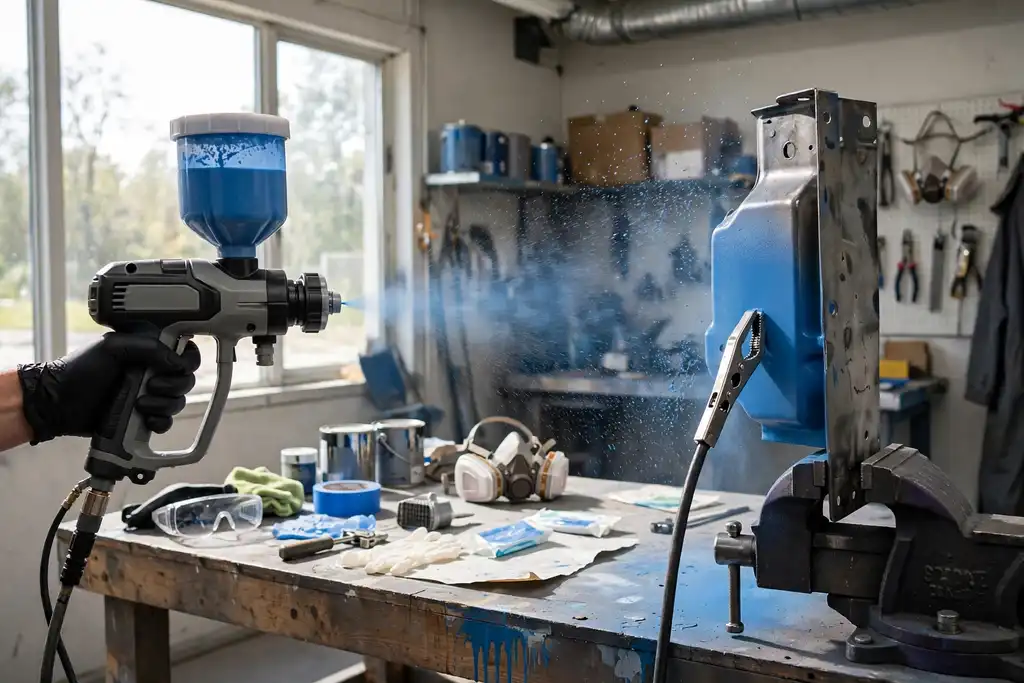
An electrostatic paint sprayer charges paint particles as they leave the nozzle, then attracts them to a grounded object for less overspray and better wrap-around coverage. Proper grounding is essential for the effect and for safety.
Here is a clear, practical look at how does a electrostatic paint sprayer work.
You’ve got the garage door open, a cabinet door propped on sawhorses, and a spray gun in your hand. Before you pull the trigger, you need to know how the charge actually moves paint, because getting it wrong means uneven coats and a mess you’ll have to sand off. How does a electrostatic paint sprayer work is really a question about attraction: the gun charges the paint, and the grounded part pulls it in.
This breakdown gives you the working principle in plain terms, then focuses on the mistakes that cause poor adhesion, shock risks, and wasted material. You’ll finish knowing how to set up, ground, and spray so the job is right the first time.
How Does a Electrostatic Paint Sprayer Work? the Charged-Particle Answer
An electrostatic paint sprayer charges paint particles so they pull toward a grounded target. That single idea explains the coverage, the safety rules, and most of the mistakes first-time users make.
| Situation | What it means | What to do |
|---|---|---|
| You skip grounding the workpiece | Charge has nowhere to go, so attraction weakens and stray charge builds | Clamp a ground wire to bare metal before spraying |
| Paint wraps into recesses | Wrap-around coverage reaches edges a normal gun misses | Slow your passes and keep the gun a consistent distance away |
| Coating builds inside corners | The Faraday cage effect pulls paint to the nearest surfaces | Use lower voltage or a narrower nozzle in deep recesses |
| Overspray drops sharply | Higher transfer efficiency means less airborne paint | Still mask and ventilate, since some overspray remains |
| Paint film looks uneven or runny | Charged particles can over-attract and pile up | Reduce fluid flow and test on scrap first |
| You spray near solvent vapors | High voltage plus flammable fumes is a real ignition risk | Ventilate, bond equipment, and follow OSHA and manufacturer rules |
Recommended for this job

EvaClean Protexus Cordless Battery Powered Electrostatic
Its 60-micron nozzle charges disinfectant droplets so they cling to surfaces electrostatically.

Victory Innovations Cordless Electrostatic Handheld Sprayer
Its 3-in-1 nozzle charges sanitizer droplets for wraparound electrostatic surface coverage.

Victory Innovations Cordless Electrostatic Backpack Sprayer
Its electrostatic charging makes disinfectant droplets attract to surfaces for even coverage.
The 30-second Version: Charged Paint, Grounded Target
A spray gun sends paint through a nozzle, where an electrode applies a high voltage. That gives each droplet an electrical charge, and the grounded object pulls those paint particles in. Atomization, the breaking of liquid into fine droplets, still comes from air pressure or the pump.
Why Paint Curves Around Edges Instead of Blowing Past Them
Charged droplets follow the electric field toward the grounded surface, so they bend around edges. That is wrap-around coverage: the back and sides of a part get coated with less aiming. It also cuts overspray, the airborne paint that lands where you did not intend, and raises transfer efficiency.
Overspray is airborne paint that lands on unintended surfaces, which electrostatic attraction helps reduce.
What the Electric Field Actually Does Between Gun and Surface
The field is the invisible pull between the charged gun and the grounded target. It steers droplets onto the part, but it also drags them into recesses, which is the Faraday cage effect. Grounding is what completes the circuit, so a loose clamp or painted hook breaks the whole principle.
Charge It, Ground It, Spray It: Setting up in the Right Order
Sequence matters more than settings. Ground first, then power, then spray, and you avoid shocks and weak coverage.
Step 1: Ground the Object Before You Plug in the Gun
Clip the ground wire to bare metal, not paint, and check continuity with a multimeter set to ohms; you want under 1 ohm. A poor ground means the electrical charge has nowhere to go, so paint particles drift and overspray rises.
Step 2: Dial Voltage and Fluid Flow to the Paint, Not the Other Way Around
Set high voltage at the low end of the maker’s range, typically 40 to 60 kV for solvent paints. Open fluid flow a quarter turn at a time; thick coatings need more atomization, thin ones less.
Step 3: Test the Pattern on Scrap, Then Commit to Passes
Spray scrap card at your working distance and look for an even fan with no tails. Adjust the nozzle and flow once, then stop fiddling; each change alters the Faraday cage effect around edges.
Step 4: Keep the Gun Perpendicular and Moving at a Steady Distance
Hold the spray gun 8 to 12 inches away and square to the surface. Overlap passes by half to build transfer efficiency and wrap-around coverage without stripes or sags.
Set up in this order and you avoid the two failures that ruin electrostatic jobs: a weak ground and a flooded pattern.
How Paint Particles Pick up Their Charge
Corona Charging at the Electrode Tip
High voltage, typically tens of thousands of volts, gets fed to a sharp electrode sitting at the nozzle tip. That concentrated voltage ionizes the air around the tip, creating a corona of charged particles. As paint passes through this cloud, the paint particles grab that electrical charge on their way out.
Why Atomization and Charging Happen at the Same Moment
The spray gun breaks the paint into a fine mist and charges it in the same pass. Atomization, which is simply the paint being shattered into tiny droplets by air or pressure, happens right where the electrode’s field is strongest. So each droplet leaves the nozzle already carrying a charge, and the spray pattern stays tight because charged droplets repel each other instead of drifting.
What Happens to the Charge When the Droplet Lands
Once a charged droplet reaches your grounded workpiece, the charge flows off through the ground path and the droplet stays put. That is why grounding is non-negotiable: without it, charge builds up on the part and paint particles stop being attracted, killing transfer efficiency and raising shock risk. A properly grounded part also pulls paint around edges, giving you wrap-around coverage that plain air spraying cannot match.
When Electrostatic Spraying Actually Works Best
Complex Shapes, Edges, and Tubular Shapes
Electrostatic attraction pulls charged paint toward the workpiece, giving wrap-around coverage on edges and the backs of tubular frames a standard spray gun would miss. Less paint floats away as overspray, so more of what leaves the nozzle lands on the part, that’s transfer efficiency.
Metal Parts That Can Be Properly Grounded
Grounded metal is non-negotiable. Attach the ground clamp to bare metal, keep the path clean, and verify continuity before spraying, skip it and you get poor coverage plus a real shock risk. Ground the panel or rack, not just the booth frame. Bare steel and aluminum work well; heavily painted or plastic parts need another approach.
Medium-To-Large Batches Where Overspray Savings Add up
Batch work is where the economics make sense. Spraying cabinet doors, metal art, or several car panels in one session lets reduced overspray and better transfer efficiency pay back setup time. Small one-off jobs often don’t justify the grounding prep and cleanup, so plan batches to keep the gun charged and parts grounded between coats.
Three Electrostatic Sprayer Myths That Cost You Money
Myth: the Power Makes Paint Stick to Anything. Fact: Ungrounded or Non-Conductive Surfaces Break the Circuit
Charge does nothing unless the target completes a circuit back to the unit. Plastic, sealed wood, or ungrounded parts get no attraction and behave like ordinary spray. Ground the part, or use a grounding additive or conductive primer first, otherwise you get patchy coverage and static shock.
Myth: More Voltage Always Means Better Coverage. Fact: Too Much Voltage Causes Wrap-Around and Uneven Build
Excess voltage pushes particles around edges and onto the back, causing unwanted overspray. Start low, test on scrap, and raise only until coverage smooths. Adjust voltage and fluid flow together; high voltage with heavy fluid can sag.
Myth: Electrostatic is Just a Fancy HVLP. Fact: the Transfer Mechanism and Grounding Requirements Are Different
HVLP relies on air and atomization alone. Electrostatic adds a charged electrode at the nozzle, so particles seek the grounded target, boosting transfer efficiency and reducing bounce-back and cleanup. Conventional guns need no part grounding; electrostatic ones do, every time, different tools, different setup rules.
Your Electrostatic Spraying Action Plan
An electrostatic paint sprayer charges paint particles so they cling to a grounded object, which cuts overspray and boosts transfer efficiency. That only works when the setup is right, so plan the safety and grounding steps before you spray anything.
| Action | Why it helps | How to start |
|---|---|---|
| Best paints for electrostatic spraying | Solvent and waterborne coatings that hold a charge well | Check the maker's electrostatic-compatible list |
| Surface preparation for electrostatic painting | Clean, dry, conductive surfaces take and hold the charge | Degrease, sand, and wipe down before spraying |
| Cost and buying guide | Hobby units run a few hundred dollars; pro rigs cost more | Compare nozzle sets and voltage adjustability |
| Grounding the workpiece | Gives charged paint particles a safe path to discharge | Clamp bare metal to a known earth ground |
| Ventilation and respiratory protection | Limits solvent vapor and airborne paint exposure | Use cross-flow air and an OSHA-rated respirator |
| Voltage tuning | Too much high voltage causes uneven attraction and buildup | Start low, raise until wrap-around coverage improves |
| Test panel check | Confirms atomization and coverage before the full part | Spray scrap, inspect, then adjust distance |
| Paint usage tracking | Shows whether transfer efficiency actually improved | Weigh or measure paint before and after each job |
Match the Paint and Object to the Method Before Buying or Renting
Choose paints the manufacturer lists as electrostatic-compatible, since some formulations resist holding a charge. Confirm your object is conductive or can be grounded. Budget from a few hundred to over a thousand dollars depending on spray gun and voltage control.
Set up Grounding and Ventilation First, Then Tune Voltage
Grounding is the safety backbone: without a clean path, charged particles and the operator can build static. Clamp bare metal to a verified earth ground, keep compressor and hoses clear, and ventilate before powering up. Then raise voltage gradually from a low setting.
Spray a Test Panel, Measure Coverage, Then Scale to the Full Part
A scrap panel tells you more than any spec sheet. Check atomization, watch for the Faraday effect pulling paint into recesses, and adjust distance and voltage until coverage is even.
Surface Preparation for Electrostatic Painting
Clean, dry, slightly conductive surfaces attract paint best. Degrease, sand, and wipe away dust so charge holds evenly and coating bonds.
Track Paint Used per Project to Confirm the Efficiency Gain
Measure paint before and after each job. If usage barely drops, revisit grounding, voltage, and spray distance before blaming equipment.
Cleaning and Maintaining an Electrostatic Sprayer After the Job
Power Down, Discharge, and Flush the Fluid Path
Shut off the high voltage, unplug the unit, and trigger the spray gun into a grounded metal bucket to bleed stored electrical charge. Then flush the fluid path with the manufacturer’s solvent until clear, 2 to 5 minutes for waterborne coatings, longer for heavy solids. Never flush flammable solvents through an energized unit.
Clean the Electrode and Air Cap Without Bending the Pin
Wipe the electrode and air cap with a soft cloth dampened with compatible solvent; never poke the charging pin. A bent pin distorts the electrical charge field and ruins wrap-around coverage. Inspect the nozzle for dried paint, clogs cause uneven atomization and more overspray.
Store the Gun so the Charging Components Stay Dry and Undamaged
Hang the gun or case it with the nozzle pointed down so solvent drains from the electronics. Moisture and paint residue quickly kill a high voltage circuit. Keep the air compressor line filtered and drained, and store above freezing.
Grounding Mistakes That Cause Shocks and Fires
The Ungrounded Workpiece: the Most Common and Most Dangerous Error
Without a proper ground, charge builds on the workpiece until it finds a path, often through you. Always clamp the workpiece to a bare metal ground point before starting. Grounding gives accumulated charge a safe route to earth; skip it and you risk shocks or a spark near solvent vapor.
Why You Never Spray Solvent-Based Coatings Without Ventilation and Bonding
Solvent vapors are flammable and a stray spark can ignite them. Bonding connects workpiece and spray gun to the same ground so no static difference builds. Combine with real airflow to remove fuel and ignition source. Check the safety data sheet for ventilation requirements; OSHA expects vapor exposure control even in a garage.
How to Verify a Real Ground Connection Before Pulling the Trigger
Test, don’t assume. Use a multimeter to confirm low resistance (typically under a few ohms) between workpiece and known ground; a loose clamp on painted metal reads as open circuit.
- Clamp to bare metal, not coating.
- Check the ground wire and plug.
- Re-verify after moving the workpiece.
When Electrostatic Spraying Doesn't Pay off
The Faraday Cage Effect: Recesses and Inside Corners That Resist Coverage
Charged paint particles follow field lines, so deep recesses and inside corners (like a narrow cabinet stile) end up starved of coating. That is the Faraday cage effect: the geometry shields itself from the electrical charge. Expect thin spots unless you adjust.
Fix it by dropping high voltage to 40 to 60 kV, moving the spray gun within 8 to 12 inches, and spraying those areas first at a 45-degree angle. A slower pass at a slow but steady pass with reduced atomization helps paint wrap in rather than bounce off.
Non-Conductive or Ungroundable Materials
Plastic, bare wood, and rubber lack a grounding path, so the electrical charge never builds and transfer efficiency drops to near zero. These surfaces need a conductive primer (typically 1 to 2 mils dry) or a different spray method. Metal and properly grounded car panels are the natural fit.
Tight Spaces and One-Off Small Jobs Where Setup Eats the Savings
For a single chair or a 6-foot section of trim, the 20 to 30 minutes spent grounding, dialing in the nozzle, and cleaning the gun can exceed the paint you save. Rent or borrow before buying.
DIY homeowners get real value on full rooms of doors and trim (10 or more pieces). Artists and car painters should weigh transfer efficiency gains against the 2 to 4 hour learning curve; a pro shop with steady volume justifies the investment faster than a one-project garage.
How Do Electrostatic Spray Guns Work? Air-Assisted, Airless, and HVLP Compared
Air-Assisted Electrostatic: the All-Rounder for Fine Finishes
Air-assisted models combine compressed air with the electrical charge, giving you the finest control over atomization, which is the breaking of paint into tiny droplets. The air compressor feeds the spray gun while the electrode at the nozzle charges the paint particles. This setup suits furniture, trim, and automotive panels where a smooth, even coat matters.
Airless Electrostatic: High Output for Large Flat and Metal Work
Airless units push paint at high pressure through a small nozzle, so you cover big surfaces fast without an air compressor. The trade-off is less finesse and more material volume, which makes grounding critical. Check that your workpiece is properly grounded before you pull the trigger, or the charge has nowhere to go.
HVLP Electrostatic: Softer Pattern with Less Bounce-Back
HVLP electrostatic guns use low pressure and high volume to lay down a gentler pattern, which cuts bounce-back and overspray on complex shapes. Choose this type for cabinets, doors, and detailed parts where wrap-around coverage helps you reach edges and recesses. Expect a narrower spray window and slower coverage than airless on large flat panels.
- Fine finish, mixed shapes: air-assisted.
- Large flat or metal runs: airless.
- Detail work, less waste: HVLP.
Common Mistakes and How to Troubleshoot Them
Most failures trace back to setup, not the equipment. Fix the basics before you blame the tool.
Weak or Patchy Coverage: Check Ground, Voltage, and Distance First
Poor attraction usually means a bad ground or too much distance. Clean your ground clamp to bare metal and keep the gun 8 to 12 inches from the surface.
Drips and Runs from Holding the Gun Too Close or Moving Too Slow
Electrostatic attraction pulls heavy paint deposits, so close passes flood the surface. Keep your wrist moving at a steady pace and overlap strokes by about half.
Paint That Won’t Charge: Wrong Formulation or Contaminated Fluid Path
Thick or metallic paints resist charging, and dirty fluid paths kill conductivity. Thin per the manufacturer’s ratio and flush the system between colors.
- Best paints for electrostatic spraying: thin lacquers, enamels, and stains formulated for electrostatic use.
- Faraday cage effect: recessed areas get starved, so spray those edges first and from a slight angle.
- Overspray still happens: mask adjacent surfaces and ventilate per OSHA guidance.
- Poor attraction usually means a bad ground or too much distance. Clean your ground clamp to bare metal and keep the gun 8 to 12 inches from the surface.
- Electrostatic attraction pulls heavy paint deposits, so close passes flood the surface. Keep your wrist moving at a steady pace and overlap strokes by about half.
- Thick or metallic paints resist charging, and dirty fluid paths kill conductivity. Thin per the manufacturer's ratio and flush the system between colors.
- Best paints for electrostatic spraying: thin lacquers, enamels, and stains formulated for electrostatic use.
- Faraday cage effect: recessed areas get starved, so spray those edges first and from a slight angle.
- Overspray still happens: mask adjacent surfaces and ventilate per OSHA guidance.
When to Call a Pro Instead of DIY
Solvent-Based Coatings in Enclosed Spaces: Ventilation and Fire Risk
Stop and hire a pro if you plan to spray solvent-based coatings in a garage or booth without engineered ventilation. Those fumes are flammable, and a spark from any source can ignite them. OSHA-style airflow and explosion-proof equipment are not DIY territory.
High-Voltage Equipment Faults, Arcing, or Repeated Shocks
Any arcing, crackling, or repeated shock means the unit is faulty and you should unplug it and call a qualified technician. A failing electrode or damaged cable on a high voltage spray gun is a fire and shock hazard. Do not tape it up and keep spraying.
Production-Scale or Automotive Finish Work Where Film Build Must Be Exact
Call a professional for full automotive resprays or any job where film build and color match must be precise. A pro controls grounding, atomization, and booth conditions to hit spec. DIY attempts often cost more in rework than the job would have.
- Stop if you cannot verify a solid grounding path for the workpiece.
- Stop if the space lacks adequate ventilation for the coating you are using.
- Stop if the spray gun shows arcing, crackling, or gives you shocks.
- Stop if you are spraying a full vehicle or production batch to an exact film build.
- Stop if local rules require a certified booth or licensed applicator for your coating.
How Does a Electrostatic Paint Sprayer Work: Frequently Asked Questions
?How Does a Electrostatic Paint Sprayer Work Safely on a Metal Car Panel?
It charges paint particles and pulls them to a grounded panel, so the panel must be grounded first. Connect the ground clamp to bare metal, keep the high voltage on only while spraying, and never spray near open flames or solvent vapors. The electrical charge is what makes it work, so a bad ground means shocks and flash risk.
?Can a Electrostatic Paint Sprayer Work on Wood or Plastic Without Grounding?
No, it needs a ground path or the paint particles have nowhere to go. Wood and plastic don't conduct, so use a grounding wire or conductive additive made for the coating. Without grounding, transfer efficiency drops and overspray climbs. Set up grounding before you fill the cup, not after.
?How Does a Electrostatic Paint Sprayer Work Differently from a Regular Spray Gun?
It adds an electrical charge to the paint particles, while a regular spray gun relies on air alone. The charge pulls paint to the target, cutting overspray and boosting transfer efficiency. A regular spray gun needs no grounding. That single difference drives the setup, safety rules, and why the electrostatic paint sprayer costs more.
?Why Does My Electrostatic Paint Sprayer Work Poorly Inside Corners?
The Faraday cage effect blocks the charge from reaching recessed areas. The grounded surface surrounds the corner, so paint particles are pulled to the edges and skip the inside. Slow down, keep the nozzle perpendicular, and don't overcharge. Accept that some corners need a touch-up pass with a conventional spray gun.
?What Nozzle and Electrode Setup Makes a Electrostatic Paint Sprayer Work Best?
Match the nozzle to your coating viscosity and keep the electrode clean. The nozzle controls fluid flow, and the electrode is the point that puts the electrical charge on the paint particles. A dirty or bent electrode weakens the charge. Check both before every job, and replace worn parts rather than cranking up the high voltage.
?When Does a Electrostatic Paint Sprayer Work with an Air Compressor, and When is It Airless?
Air-assisted and HVLP models use an air compressor to help atomization, while airless versions use fluid pressure alone. Air-assisted units give finer atomization and better wrap-around coverage on complex shapes. Airless units push thicker coatings faster. Check your coating spec and your air compressor output before buying.
?is It Worth Learning How Does a Electrostatic Paint Sprayer Work for a Small DIY Job?
Only if the job has enough parts to justify the setup time. Grounding, cleaning, and tuning take longer than a brush or a simple spray gun on one small piece. For railings, cabinet doors, or car panels, the transfer efficiency and wrap-around coverage pay off. For a single chair, skip it.
Our Thoughts
Charged paint particles plus a grounded target equals less overspray, meaning less paint landing where you did not intend it, and stronger wrap-around coverage on edges and recesses. Skip the grounding and you lose the attraction, the transfer efficiency, and the safety margin. So treat the ground connection as part of the job, not an optional extra.
Your next step: before you fill the cup, confirm a clean ground path from the spray gun to the workpiece and check the electrode and nozzle for damage. If the surface is non-conductive or boxed in, plan for the Faraday cage effect, where the electrical charge keeps paint from reaching recessed areas. Then practice on scrap to dial in atomization and distance.