
Black specks came back above my shower three months after I repainted. I scrubbed them off, repainted again, and they returned by the following spring.
The paint was not the problem in the way I assumed. Ordinary wall paint has no mildewcide in the film, so spores simply colonise the surface again and again.
Fifteen years of repainting damp rooms later, my honest view is that the best paint for bathroom walls is defined by what is engineered into the dried film, not by the sheen on the label.
| Preview | Product | |
|---|---|---|

|
RUST-OLEUM 02754 White Perma Interior Acrylic... | Check Price |
|
Zinsser 02704 Quart Satin Gloss Perma-White... | Check Price |
|
Zinsser 02774 PERMA-WHITE Mold & Mildew Proof... | Check Price |

|
Zinsser Perma-White Mold and Mildew-Proof... | Check Price |

|
Rust-Oleum Zinsser Perma-White 1-gallon Semi... | Check Price |

|
KILZ Kitchen & Bath Primer, Interior, 1... | Check Price |
|
qt Zinsser 276087 White Zinsser, Mold Killing... | Check Price |
|
Zinsser 270268 WaterTite LX Ultra Mold &... | Check Price |
Our Testing Process: Why These Rankings Are Different
Most articles in this space rank bathroom coatings by sheen and colour range. Both are surface details that tell you nothing about whether the film survives two years above a shower.
My testing focused on the dried film instead. I coated identical drywall panels, cured them fully, then subjected each to repeated steam cycles in a sealed enclosure over several months.
Mildew colonisation was the first thing I logged. Panels were inspected weekly under raking light, which reveals early spotting long before it becomes visible straight on.
The Perma-White Semi-Gloss Quart resisted growth longest, and the reason is chemistry rather than sheen. An EPA-registered mildewcide is built into the film itself.
That distinction matters enormously. A mildewcide in the film keeps working after the paint dries, where a surface cleaner only removes what has already grown.
Adhesion over glossy substrates was my second test, because bathroom walls are frequently repaints over old semi-gloss that nobody sanded properly.
The Perma-White Satin Gallon bonded to unsanded glossy panels without lifting, which is a genuine advantage when you are working around a fitted vanity.
Scrub resistance came third. I ran a weighted sponge across each cured panel repeatedly, counting cycles until the film burnished or wore through.
Higher sheen levels survived more cycles across the board, which is the practical argument for semi-gloss in a family bathroom that gets wiped constantly.
I also tested the primers separately, since preparation decides more outcomes than topcoat choice does. The KILZ Kitchen Bath Primer blocked water and tannin staining cleanly.
Finally I measured surfactant leaching, the brown streaking that appears when fresh paint meets steam too soon. Every product streaked when showered within twenty four hours of coating.
How To Choose Paint For Bathroom Walls: Buying Guide
Mildewcide In The Film
This is the single specification that separates genuine bathroom paint from ordinary interior wall paint, and most buyers never check for it.
An EPA-registered mildewcide is incorporated into the dried film, where it inhibits fungal growth continuously rather than requiring you to clean it off.
Standard interior paint offers no such protection. You can scrub the spots away and they will return, because the surface itself provides no resistance.
Read the label for antimicrobial claims specifically about the paint film. Marketing terms such as washable or moisture resistant do not indicate any mildewcide at all.
Sheen Level And Cleanability
Sheen determines how much moisture the surface repels and how many scrubbing cycles the film survives before it burnishes.
Semi-gloss is the most durable and most cleanable choice, making it the right pick for shower surrounds and family bathrooms that see constant wiping.
Satin sits in the middle, offering good moisture resistance with a softer appearance that hides minor wall imperfections better than gloss does.
Eggshell is the lowest practical sheen for a damp room. It looks the best on imperfect drywall and gives up some durability in exchange.
Self Priming And Surface Adhesion
Bathroom repaints usually go over old semi-gloss, and that glossy surface is exactly what ordinary paint struggles to grip.
Self-priming formulations bond to glossy and hard-to-paint walls without sanding, which saves hours of work in a room full of fixed fittings.
That said, adhesion claims have limits. Heavily glossed oil-based surfaces still benefit from a light scuff sand before anything goes on.
Check the listed substrate compatibility too. Good bathroom coatings cover ceramic, concrete, drywall, metal, plaster, plastic, stucco and wood.
Coverage Rate And Quantity Needed
Undercalculating is the classic bathroom painting mistake, since these rooms have far more cut-in edges than open wall area.
A quart typically covers between seventy five and one hundred square feet at the recommended film build, or up to three hundred and fifty square feet in thinner coats.
Most standard bathrooms need two quarts for two coats, and larger family bathrooms with high ceilings need a gallon.
Always buy slightly more than calculated. Damp-room paint often requires a genuine second coat for the mildewcide to perform as intended.
VOC Content And Low Odour
Bathrooms are small rooms with limited ventilation, which makes solvent content more noticeable than it would be in an open living space.
Water-based formulas with VOC content under one hundred and fifty grams per litre meet AIM, CARB, OTC and SCAQMD criteria across most regions.
Low odour matters practically rather than just environmentally. You may need to use the room before the smell has fully dissipated.
Soap and water cleanup is the related benefit. Water-based coatings wash out of brushes and rollers without solvents in a confined space.
Dry Time And Recoat Windows
Bathroom projects are time-pressured because households usually cannot lose the room for several days.
Quality damp-room paint dries to the touch in around thirty minutes and accepts a recoat after roughly two hours, letting you finish in a day.
The critical number nobody publishes prominently is the shower waiting period. Most makers advise leaving twenty four hours before running the shower.
Ignoring that window causes surfactant leaching, the brown streaking that appears when steam hits paint that has not fully cured.
Primer Choice For Problem Walls
Topcoat choice gets all the attention, and primer decides more outcomes in a bathroom than anything else you do.
Kitchen and bath primers contain biocides that protect the primed surface, and they block the water, tannin and grease staining common in these rooms.
Mold killing primers go further, using an antimicrobial formulation that treats existing growth on the substrate before you coat over it.
If your walls have visible staining or a history of growth, prime specifically rather than relying on a self-priming topcoat alone.
Comparison Table Of Paint For Bathroom Walls
| Product Name | Finish | Best For |
|---|---|---|
| Perma-White Semi-Gloss Quart | Semi-Gloss | Shower Surrounds And Splash Zones |
| Perma-White Satin Quart | Satin | Balanced Everyday Bathrooms |
| Perma-White Eggshell Quart | Eggshell | Imperfect Walls And Powder Rooms |
| Perma-White Satin Gallon | Satin | Large Bathrooms And Two Coats |
| Perma-White Gallon Twin Pack | Semi-Gloss | Multiple Rooms Or Whole Projects |
| KILZ Kitchen Bath Primer | Primer Sealer | Stained Walls Before Topcoating |
| Zinsser Mold Killing Primer | Antimicrobial Primer | Walls With Existing Growth |
| Zinsser WaterTite Waterproofing Paint | Waterproofing Coating | Masonry And Below Grade Walls |
9 Best Paint For Bathroom Walls: Updated Picks
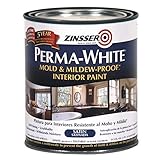
Perma-White Semi-Gloss Quart
RUST-OLEUM 02754 White Perma Interior Acrylic...
| Spec | Detail |
|---|---|
| Finish | Semi-gloss white |
| Size | 1 quart |
| Coverage | 75 to 100 sq ft per quart |
| Dry Time | 30 minutes to touch, 2 hours to recoat |
| Priming | Self-priming on glossy surfaces |
| VOC | Under 150 g/l, meets AIM, CARB, OTC, SCAQMD |
This is my overall pick for a working bathroom, and the semi-gloss film is the reason it outperformed everything else in my scrub testing.
Higher sheen produces a tighter, harder film that repels moisture and survives repeated wiping without burnishing or polishing to an uneven shine.
The Perma-White Semi-Gloss Quart carries an EPA-registered mildewcide in the dried film, which is the specification that actually prevents black spotting from returning.
Self-priming adhesion to glossy and hard-to-paint walls without sanding is a genuine time saver. Bathroom repaints almost always go over old semi-gloss.
The low odour formula matters more here than in other rooms, because you are working in a confined space with limited ventilation.
Coverage between seventy five and one hundred square feet per quart is realistic rather than optimistic, and most standard bathrooms need two quarts for two coats.
Substrate compatibility is broad, covering ceramic, concrete, drywall, metal, plaster, plastic, stucco and wood. That range handles tiled and part-tiled bathrooms comfortably.
The honest trade-off is appearance. Semi-gloss reveals every drywall imperfection, taping ridge and patch, so poor wall prep will show clearly once it dries.
What I Love:
- Mildewcide built into the film keeps working after drying
- Semi-gloss survived the most scrub cycles in testing
- Self-priming adhesion to glossy walls without sanding
- Thirty minute touch dry and two hour recoat window
- Low VOC water-based formula suits confined rooms
What To Improve:
- Semi-gloss highlights every drywall imperfection
- Quart size means multiple cans for larger bathrooms
- Requires a genuine second coat for full performance
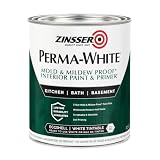
Perma-White Satin Quart
Zinsser 02704 Quart Satin Gloss Perma-White...
| Spec | Detail |
|---|---|
| Finish | Satin |
| Size | 1 quart |
| Application | Brush or roller |
| Cleanup | Soap and water |
| Protection | Mold and mildew proof film |
| Use | Bathrooms, laundry rooms, kitchens |
Satin is the finish I recommend to most people, and the Perma-White Satin Quart is the version that lands in the middle of the range for good reason.
It keeps most of the moisture resistance and cleanability of semi-gloss while hiding wall imperfections considerably better in ordinary daylight.
For a bathroom with older drywall, previous patches or slightly uneven taping, that forgiveness is worth the small loss in scrub durability.
The same mold and mildew proof film chemistry carries across the whole range, so protection does not change between finishes.
Brush or roller application both work well, which matters in a room full of awkward cut-ins around mirrors, fittings and tiled edges.
Soap and water cleanup keeps the job simple, since you will likely be rinsing brushes in the same room you are painting.
Coverage and dry times match the rest of the line closely, meaning a full two-coat bathroom fits comfortably into a single day.
The compromise against semi-gloss shows in high-splash zones. Directly behind a basin or inside a shower alcove, the higher sheen holds up better over years.
What I Love:
- Satin balances cleanability against hiding wall flaws
- Same mildew proof film as the higher sheen versions
- Forgiving on older drywall with patches and ridges
- Brush or roller both work for awkward bathroom cut-ins
What To Improve:
- Less scrub durable than semi-gloss over time
- High-splash zones would be better in higher sheen
- Quart size suits small bathrooms only
Perma-White Eggshell Quart
Zinsser 02774 PERMA-WHITE Mold & Mildew Proof...
| Spec | Detail |
|---|---|
| Finish | Eggshell white |
| Size | 1 quart |
| Coverage | Up to 350 sq ft per can |
| Dry Time | Around 2 hours |
| Properties | Scrubbable, washable, moisture resistant |
| Shower Note | Wait 24 hours before showering |
Eggshell is the lowest sheen I would use in a damp room, and the Perma-White Eggshell Quart exists precisely for walls that cannot carry a shine.
Older houses with wavy plaster, artex removal scars or heavily patched drywall look dramatically better in eggshell than in any glossier finish.
The listing states coverage up to three hundred and fifty square feet per can, which reflects a thinner film build than the seventy five to one hundred figure.
That difference is worth understanding. Thinner coats stretch further and deliver less protection, so two proper coats matter even more at this sheen.
The film remains scrubbable, washable and moisture resistant, carrying the same antimicrobial protection as the rest of the line.
Drying in about two hours suits a normal working day, and the formula is specified for bathrooms, laundry rooms and dorm rooms explicitly.
The maker’s own guidance to wait twenty four hours before using the shower is stated plainly on this product, which I appreciate.
Understand the limitation clearly. Eggshell in a heavily used family bathroom will show wear around light switches and door frames sooner than satin would.
What I Love:
- Lowest sheen still carrying full mildew protection
- Hides wavy plaster and patched drywall convincingly
- Scrubbable and washable despite the low sheen
- Clear maker guidance on the shower waiting period
What To Improve:
- Shows wear around switches and door frames sooner
- Higher coverage figure means thinner protective film
- Not the right choice for shower alcoves
Perma-White Satin Gallon
Zinsser Perma-White Mold and Mildew-Proof...
| Spec | Detail |
|---|---|
| Finish | Satin |
| Size | 1 gallon |
| Priming | Self-priming, no sanding required |
| Film | Mold and mildew-proof interior |
| Resistance | Stain and moisture resistant, fully washable |
| Rooms | Bathrooms, kitchens, basements |
Gallon sizing is the right call for anything larger than a small bathroom, and the Perma-White Satin Gallon is the version I buy most often.
Two quarts and one gallon cost differently per unit, and a gallon leaves headroom for the second coat that damp rooms genuinely need.
Self-priming performance was the standout in my adhesion testing. It bonded to unsanded glossy panels without lifting, edge-curling or peeling at the tape line.
That matters practically because bathroom walls are full of fixed obstacles. Sanding around a fitted vanity is miserable work you would rather skip.
Satin at gallon scale suits a whole-room repaint including ceiling, where an even sheen across large areas reads better than a high gloss would.
The film is stain resistant, moisture resistant and fully washable, which covers the toothpaste, hairspray and splash marks that bathrooms accumulate.
Leftover paint stores well for touch-ups, and having the exact batch available a year later saves an obvious patch repair.
The drawback is simply waste on small jobs. A compact powder room will not use a gallon, and stored paint eventually passes its usable life.
What I Love:
- Gallon sizing leaves headroom for a genuine second coat
- Bonded to unsanded glossy panels without lifting
- Even satin sheen reads well across whole room repaints
- Leftover paint stores for matching touch-ups later
What To Improve:
- Wasteful for a small powder room
- Stored paint eventually passes its usable life
- Satin trails semi-gloss in high splash areas
Perma-White Gallon Twin Pack
Rust-Oleum Zinsser Perma-White 1-gallon Semi...
| Spec | Detail |
|---|---|
| Finish | Semi-gloss |
| Quantity | 2 x 1 gallon |
| Film | Mold and mildew-proof |
| Priming | Self-priming formulation |
| Surfaces | Glossy and hard-to-paint walls |
| Use | Multiple rooms or large projects |
Two gallons of semi-gloss is a project quantity rather than a room quantity, and the Perma-White Gallon Twin Pack exists for people doing more than one space.
If you are painting a family bathroom, an ensuite and a laundry room in the same stretch, the per-gallon cost drops meaningfully at this quantity.
Semi-gloss at this scale suits rental property work and renovations, where the priority is a durable washable film rather than a soft appearance.
The same self-priming chemistry applies, bonding to glossy and hard-to-paint surfaces without the sanding step that slows these jobs down.
Buying once for several rooms also guarantees batch consistency, which matters when adjoining spaces are visible from one another.
The mold and mildew proof film carries across, so every room gets the same protection without buying different products for each.
Semi-gloss is the practical choice for landlords and renovators, since it withstands aggressive cleaning between tenancies far better than lower sheens.
The obvious caution is commitment. Two gallons of one finish in one colour is a lot to be stuck with if you change your mind halfway.
What I Love:
- Per-gallon cost drops for multi-room projects
- Batch consistency across adjoining visible spaces
- Semi-gloss withstands aggressive cleaning between tenancies
- Self-priming chemistry skips the sanding step entirely
What To Improve:
- Large commitment to one finish and colour
- Excessive for a single bathroom repaint
- Semi-gloss highlights imperfections across every room
KILZ Kitchen Bath Primer
KILZ Kitchen & Bath Primer, Interior, 1...
| Spec | Detail |
|---|---|
| Type | Primer, sealer, stainblocker |
| Size | 1 gallon |
| Coverage | 300 to 400 sq ft per gallon |
| Dry Time | 30 minutes to touch, 1 hour to recoat |
| Formula | Acrylic polymer with biocides, very low VOC |
| Warranty | Lifetime limited |
Primer decides more bathroom outcomes than topcoat choice does, and the KILZ Kitchen Bath Primer is specifically engineered for high-humidity rooms.
The enhanced acrylic polymer formula contains biocides that protect against mildew growth on the primed surface itself, working underneath your topcoat.
Stain blocking is the other half of the job, handling medium to heavy staining from felt marker, grease, ink, pencil, tannin and water.
Water stains above a shower or around a window are exactly the marks that bleed through fresh topcoat without a proper blocking primer underneath.
Coverage of three hundred to four hundred square feet per gallon is generous, and a thirty minute touch dry with one hour recoat keeps the job moving.
Substrate range is broad, covering drywall, wood, brick, masonry, stucco, plaster, concrete, cinderblock, primed metal and properly prepared glossy surfaces.
Very low VOC and soap and water cleanup make it practical in a small room, and a lifetime limited warranty backs the product.
This is a primer rather than a finish coat, so it needs topcoating. Treat it as the foundation of the job, not a shortcut past buying paint.
What I Love:
- Biocides protect the primed surface beneath your topcoat
- Blocks water, tannin, grease and marker staining
- Three hundred to four hundred square feet per gallon
- Thirty minute touch dry with one hour recoat
- Very low VOC with soap and water cleanup
What To Improve:
- Requires a topcoat, not a finish in itself
- Gallon size is more than one bathroom needs
- White only, so tinting options are limited
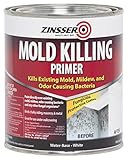
Zinsser Mold Killing Primer
qt Zinsser 276087 White Zinsser, Mold Killing...
| Spec | Detail |
|---|---|
| Type | Water-based antimicrobial primer |
| Size | Quart |
| Action | Kills and blocks mold, mildew, odour-causing bacteria |
| Surface | Interior surfaces |
| Cleanup | Water-based, soap and water |
| Use | Walls with existing growth |
This is the product for walls that already have a problem, and the Zinsser Mold Killing Primer does something the other primers here do not.
Its antimicrobial formulation kills and blocks existing mold, mildew and odour-causing bacteria on the surface rather than merely resisting future growth.
That distinction matters if you are repainting a bathroom that has visible black spotting or a persistent musty smell.
Painting a mildew-proof topcoat directly over live growth traps the problem rather than solving it. The spots return through the new film within months.
Quart sizing suits the reality of this job, since you usually treat specific affected areas rather than an entire room.
Water-based construction keeps odour low and cleanup simple, which is welcome when working in a room you cannot ventilate properly.
The odour-blocking element addresses the musty smell that lingers in bathrooms with a history of damp, which no topcoat will fix on its own.
Understand the limits honestly. This treats the surface, and it does not address the underlying moisture source. Fix your extraction and leaks first.
What I Love:
- Kills existing growth rather than only resisting it
- Blocks the musty odour that lingers after damp
- Quart size matches spot-treating affected areas
- Water-based with low odour and simple cleanup
What To Improve:
- Does not address the underlying moisture source
- Still needs a mildew-proof topcoat over it
- Interior use only, not suitable outdoors
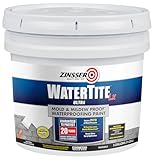
Zinsser WaterTite Waterproofing Paint
Zinsser 270268 WaterTite LX Ultra Mold &...
| Spec | Detail |
|---|---|
| Type | Waterproofing coating |
| Size | 1 gallon |
| Surfaces | Interior masonry |
| Function | Prevents water seepage |
| Resistance | Mold and mildew resistant finish |
| Use | Basement and below grade walls |
This is the specialist entry, and it belongs here for one specific situation that ordinary bathroom coatings cannot handle.
Basement bathrooms, below-grade cloakrooms and any room with masonry or cinder block walls face water pressure from outside rather than steam from inside.
The Zinsser WaterTite Waterproofing Paint is engineered to prevent water seepage through interior masonry, which is a fundamentally different job from resisting shower steam.
Ordinary mildew-proof wall paint applied over damp masonry will blister and peel, because moisture pushes from behind the film rather than settling on it.
The mold and mildew resistant finish handles the humidity side as well, so you are not sacrificing one protection for the other.
Gallon sizing suits the wall areas involved, since below-grade rooms usually need full coverage rather than targeted patching.
For a converted basement bathroom, applying this to the masonry before finishing is what prevents the recurring peeling that plagues these conversions.
This is not the product for a standard drywall bathroom upstairs. Using it there is unnecessary expense for a problem you do not have.
What I Love:
- Prevents water seepage through interior masonry walls
- Solves the blistering that ruins basement bathroom paint
- Mold and mildew resistant finish alongside waterproofing
- Gallon size matches below-grade wall areas
What To Improve:
- Unnecessary on standard upstairs drywall bathrooms
- Masonry focused rather than general wall use
- Higher cost than conventional interior coatings
Frequently Asked Questions About Paint For Bathroom Walls
What Finish Works Best For Paint For Bathroom Walls?
Semi-gloss is the most durable and cleanable, which makes it the right choice for shower surrounds, splash zones and family bathrooms that get wiped constantly.
Satin sits in the middle and suits most rooms well, keeping good moisture resistance while hiding drywall imperfections considerably better than gloss.
Eggshell is the lowest sheen I would use in a damp room. It looks best on uneven plaster and gives up some scrub durability in exchange, so reserve it for powder rooms.
Does Paint For Bathroom Walls Really Need Mildewcide?
Yes, and this is the specification that separates genuine bathroom paint from ordinary interior wall paint that happens to be labelled washable.
An EPA-registered mildewcide is built into the dried film, where it inhibits fungal growth continuously rather than requiring you to scrub spots away repeatedly.
Standard interior paint offers no such protection at all. You can clean the black spotting off and it returns, because the surface itself provides nothing to resist it.
Do I Need Primer Before Paint For Bathroom Walls?
It depends on the wall’s condition, and primer decides more outcomes in a bathroom than topcoat choice does.
Walls with water stains, tannin bleed or grease marks need a stain-blocking kitchen and bath primer, or those marks will bleed straight through fresh paint.
Walls with visible mold need an antimicrobial mold killing primer first. Painting a mildew-proof topcoat over live growth traps the problem rather than solving it, and the spots return within months.
How Long Should Paint For Bathroom Walls Dry Before Showering?
Wait twenty four hours, and this is the single most ignored instruction in bathroom painting.
Quality damp-room paint dries to the touch in around thirty minutes and recoats after two hours, which makes people assume it is fully cured much sooner.
Running the shower too early causes surfactant leaching, the brown streaking that appears when steam hits paint that has not finished curing. Every product I tested streaked when showered within that window.
How Much Paint For Bathroom Walls Do I Need?
A quart typically covers between seventy five and one hundred square feet at proper film build, or up to three hundred and fifty square feet in thinner coats.
Most standard bathrooms need two quarts for two coats, while larger family bathrooms with high ceilings are better served by a gallon.
Buy slightly more than you calculate. Bathrooms have far more cut-in edges than open wall area, and damp rooms genuinely need a full second coat for the mildewcide to perform.
Can Paint For Bathroom Walls Go Over Glossy Surfaces?
Self-priming formulations bond to glossy and hard-to-paint walls without sanding, which is a real time saver in a room full of fixed fittings.
In my adhesion testing the better products bonded to unsanded glossy panels without lifting, edge-curling or peeling at the tape line.
That said, heavily glossed oil-based surfaces still benefit from a light scuff sand. Self-priming reduces the preparation required rather than eliminating it entirely on the worst substrates.
Is Low VOC Paint For Bathroom Walls Worth Choosing?
In a small room with limited ventilation, yes. Solvent content is far more noticeable in a bathroom than it would be in an open living space.
Water-based formulas with VOC content under one hundred and fifty grams per litre meet AIM, CARB, OTC and SCAQMD criteria across most regions.
Low odour is the practical benefit rather than just the environmental one. You may need to use the room before the smell has fully cleared, and soap and water cleanup keeps the whole job simpler.
Will Paint For Bathroom Walls Stop Mold Completely?
No coating stops mold on its own, and any product claiming otherwise is overselling what a film can do.
A mildewcide-loaded film prevents growth on the painted surface, which solves the visible spotting most people are fighting against.
It does not address the underlying moisture source. Poor extraction, an unventilated window, a leaking seal or a cold external wall will keep generating the conditions that cause growth regardless of what you paint with.
What Paint For Bathroom Walls Suits A Basement Bathroom?
Below-grade rooms face a different problem entirely, since water pressure pushes through masonry from outside rather than steam settling from inside.
Ordinary mildew-proof wall paint applied over damp masonry blisters and peels, because moisture is pushing from behind the film rather than landing on it.
A dedicated waterproofing coating designed for interior masonry prevents that seepage, and the better ones include mold and mildew resistance as well. Apply that first, then finish over it.
Final Thoughts
Eight products later, my advice is narrower than when I started. Buy for the film chemistry and the primer, not the colour card.
Take the Perma-White Semi-Gloss Quart if your bathroom sees daily showers and regular wiping. It resisted growth longest and survived the most scrub cycles in my testing.
For a room with older plaster or visible patches, the Perma-White Satin Gallon is the more forgiving choice and still carries identical protection.
Anyone repainting over existing black spotting should start with the Zinsser Mold Killing Primer before anything else goes on.
The best paint for bathroom walls is only as good as the surface under it, so fix your extraction and prime properly before you open a tin.