
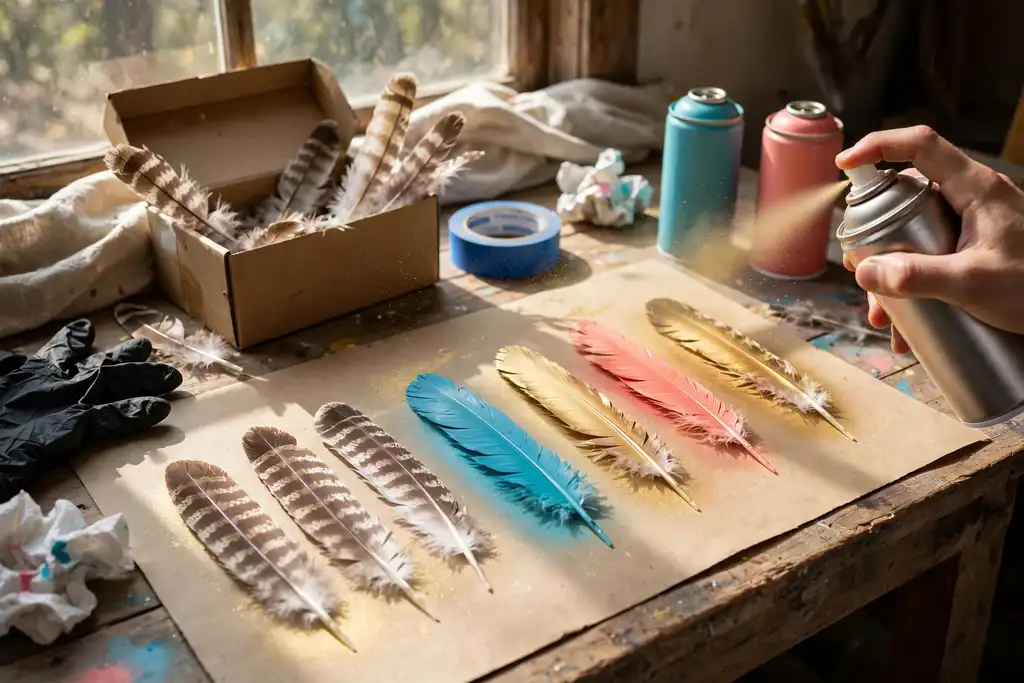
Yes, you can spray paint feathers, but only with light coats over a primer base and full ventilation, because heavy coats mat the barbs and trap solvent, ruining flexibility and finish.
Recoloring a batch of feathers for a costume, wreath, or wall piece without turning them into stiff, clumped messes starts with knowing what spray paint can and cannot do. Can you spray paint feathers? Yes, with the right prep and restraint, but the wrong technique will mat the barbs and leave a tacky finish that never fully cures.
You will get the exact steps for prepping craft feathers and natural feathers, applying light coats of spray paint over a primer coat, managing drying time, and sealing the result so flexibility survives handling. Safety comes first: a respirator and real ventilation are non-negotiable, and acrylic paint remains the better choice for small or delicate pieces.
Can You Spray Paint Feathers? Yes, but Read This First
Yes, you can spray paint feathers, and it works well when you match the product to the bird. Real plumage and dyed craft feathers behave differently, so pick your method before you pick a color.
| Situation | What it means | What to do |
|---|---|---|
| Natural feathers | Oily, layered surface resists paint | Degrease, use primer, apply light coats |
| Craft feathers | Dye-friendly, often already treated | Light coats, no heavy soak |
| Heavy single coat | Matts barbs, kills flexibility | Switch to several light coats |
| No primer on dark plumage | Color shifts or looks muddy | Prime light first, then color |
| Indoor spraying | Fumes build fast in closed rooms | Spray outdoors or use ventilation |
| Sealing skipped | Paint flakes off on costume wear | Seal after full drying time |
| Wet handling | Smears and clumps barbs | Wait out drying time, handle dry |
Recommended for this job

Pixiss 12 Color Shimmer Spray Bundle
Its fine shimmer mist lightly coats feathers with pearlescent color without heavy soaking.

Odor/Particulate Multipurpose Respirator
The respirator filters paint fumes and particles while spraying paint onto feathers safely.

Colorful Craft Rooster Feathers 3- Bulk
These bulk craft feathers give you plenty of practice pieces for spray painting tests.
Spray paint coats the barbs and adds weight, so a soaked feather stiffens and loses its natural flexibility. Light coats keep the structure intact and let the color build gradually. On natural feathers, a primer (a preparatory coating that helps paint bond) gives the pigment something to grip.
What Spray Paint Actually Does to Feathers
Each pass adds a thin film that dries fast but accumulates. Too much at once glues the barbs together and the feather stops moving like a feather. Work in light coats, keep the can 8 to 10 inches away, and stop before the surface looks wet.
When Spray Painting Feathers Works Best
Craft feathers take spray paint easily and hold color for decor and costume pieces. Natural feathers need degreasing with dish soap and warm water, then primer, then sealing to protect the finish through handling. Wear a respirator (a device that filters what you breathe) and spray outdoors or with a fan pulling fumes away.
Safety Steps Before You Spray
Set up outdoors or in a garage with the door open and a box fan pulling air out. A respirator rated for organic vapors, not a dust mask, keeps aerosol particles out of your lungs. Lay feathers flat on cardboard and let each light coat dry 10 to 15 minutes before the next.
Spray Painting Feathers on a Budget Without Cutting Corners
Cheap Sheets That Still Work
A flat or matte spray paint in the $5 to $10 range handles craft feathers fine, and matte hides uneven coverage better than gloss. Skip gloss, metallic, and textured finishes, since they add weight and crack when the feather flexes.
Choose cans labeled for crafts or floral use. A light coat of primer, a preparatory coating applied before paint, helps color bond on dyed or slick craft feathers. On clean, dry natural feathers, two light coats of matte paint usually hold up for indoor decor.
How Many Feathers per Can?
One standard 10 to 12 ounce can covers roughly 20 to 40 craft feathers in light coats. Large natural feathers soak up more paint, so budget closer to 15 to 20 per can.
Hold the can 8 to 12 inches away and use two or three thin passes rather than one wet coat. Heavy soaking wastes paint and stiffens the quill, which ruins the drape on a costume piece.
Where to Save and Where Not to
Save on paint brand and spend on a fitted respirator, a device that filters vapors so you do not inhale them. Do not cut corners on ventilation, mask fit, or drying time, because solvent buildup and tacky paint cause most ruined projects.
- Save: generic matte cans, cardboard work boards, acrylic paint, a fast-drying paint of pigment bound in acrylic emulsion, for touch-ups.
- Do not save: a box fan in a garage or open window, a NIOSH-rated respirator, or sealing supplies for outdoor decor.
Your Action Plan for Spray Painting Feathers
Spray paint can recolor feathers, but only with the right prep, thin passes, and full cure time. Follow these four steps and you get even color without matted, stiff, or flaking results.
| Action | Why it helps | How to start |
|---|---|---|
| Clean feathers | Removes oils and dust so coating bonds | Wash in mild soapy water, rinse, dry flat |
| Test scrap feathers | Reveals reaction before risking good stock | Spray one craft feather, check after drying time |
| Apply primer | Preparatory coating that helps paint grip | Mist a thin layer, let it set per label |
| Spray light coats | Prevents pooling and preserves flexibility | Hold 8 to 12 inches away, sweep in passes |
| Work with ventilation | Limits inhaling aerosol fumes and mist | Spray outdoors or use a fan and respirator |
| Seal the finish | Locks color and reduces rub-off | Apply thin clear coat, cure fully before use |
| Allow drying time | Prevents smudging and stiff clumps | Air dry 1 to 2 hours, cure 24 hours or more |
Clean feathers in mild soapy water, rinse, and dry flat so oils and dust don’t block adhesion.
Prep: Clean and Sort Feathers
Sort by size and type, then test one scrap feather with your chosen spray paint before touching the good ones.
Test on Scrap Feathers First
Mist a light coat of primer, then build color in thin passes from 8 to 12 inches away. Work outdoors or with strong ventilation and wear a respirator, a device that supplies filtered air, because aerosol fumes add up fast.
Spray in Light Coats
Air dry 1 to 2 hours, then cure 24 to 48 hours before handling. Finish with sealing for decor or costume pieces, and use acrylic paint for touch-ups where flexibility matters.
Dry and Cure Properly
How to Spray Paint Feathers Step by Step
Set up Ventilation and PPE
Work outdoors or in a garage with the door open and a fan pulling fumes away. Wear a respirator rated for organic vapors, nitrile gloves, and eye protection. OSHA recommends this protection for aerosol paints.
Clean and Dry Your Feathers
Wash natural feathers in lukewarm water with a drop of mild dish soap, swish gently, and rinse. Pat dry, then air-dry completely for at least 2 hours; moisture trapped under paint causes flaking.
Test Compatibility on Scrap
Spray a scrap feather and let it cure for 24 hours. Check for curling, stiffness, or bleed-through; if it stays soft and the color holds, proceed.
Apply Thin Coats
Hold the can 8 to 12 inches away and mist on a light coat, moving steadily. Wait 10 to 15 minutes between coats; apply 2 to 3 coats total, since heavy passes mat the barbs.
Keep Feathers Flexible
Between coats, gently flex the shaft and separate barbs to prevent bridging. After the final coat, dry for the full time on the can, typically 1 to 2 hours. For durability, seal with a flexible clear craft coat.
Follow these steps to recolor feathers cleanly and safely, with minimal risk of matting or flaking.
Natural vs Craft Feathers: Which Takes Spray Paint Better?
Natural Feathers: Oils, Dust, and Prep
Real feathers carry natural oils and dust that keep spray paint from gripping. Wash them in warm water with a drop of mild dish soap, rinse well, and let them air dry completely before you paint.
A thin coat of primer, a preparatory coating that helps paint bond to a surface, gives you a more even base. Work in light coats rather than one heavy pass, and give each coat the full drying time on the can, often 1 to 2 hours.
Craft Feathers: Dye Lots and Coatings
Craft feathers usually accept spray paint well because they are cleaner and often already dyed. The catch is existing color and factory coatings, which can bleed through or resist new paint.
Test one feather first and watch for wrinkling or blotchy coverage. If the surface fights you, a light primer coat helps, and so does switching to acrylic paint, a fast-drying paint bound in an acrylic emulsion, for touch-ups.
How to Tell What You Have
Check the quill and the base of the barbs. Natural feathers have a hollow, slightly oily quill and uneven tips, while craft feathers are uniform, stiff, and often sold in matched bundles.
If you are unsure, run the water test: natural feathers absorb a little moisture and soften, while coated craft feathers bead water. Spray paint behaves differently on each, so confirm before you commit a whole batch to a costume or decor project.
Quick Checklist Before You Spray Paint Feathers
Ventilation and Respirator Ready?
Outdoors or in a garage with the door open and a fan pulling air away, work. A respirator protects your lungs better than a dust mask. Keep kids and pets out until the smell clears.
Feathers Clean and Dried?
Wash natural feathers in mild soapy water and dry fully, since oil and dust block adhesion. Craft feathers need a quick wipe. Damp feathers trap paint and clump.
Scrap Test Done?
Spray one spare feather and let it cure. Check if barbs stay soft or turn brittle; if it cracks when flexed, change your approach.
Right Paint for the Job?
Use flexible spray paint for crafts or fabric, not cheap enamel. A thin primer improves coverage on dark natural feathers; acrylic works for touch-ups.
- Ventilation: open door, run fan, fit respirator.
- Clean and dry: wash natural, wipe craft feathers.
- Scrap test: spray, cure, flex.
- Paint choice: flexible formula; primer for dark feathers.
- Light coats: dry between passes.
- Seal coat if needed for costume or decor.
- Ventilation check: open the door, run a fan, and fit your respirator before the first pass.
- Clean and dry: wash natural feathers, wipe craft feathers, and confirm no moisture remains.
- Scrap test: spray one spare feather, let it cure, then flex it to judge flexibility.
- Paint choice: pick a flexible craft or fabric formula, and add primer for dark natural feathers.
- Light coats: build color in thin passes with drying time between them, never one wet coat.
- Sealing plan: decide whether a flexible seal coat is needed for costume or decor pieces.
When Spray Painting Feathers Doesn't Work
Feathers That Must Stay Soft
Skip spray paint when the feathers need to keep their natural drape and softness. Aerosol coatings dry into a film that stiffens the barbs and reduces flexibility, so a boa or plume ends up crunchy instead of flowing.
If softness matters, tint with a light wash of acrylic paint thinned with water instead, or choose dyed feathers in the color you want.
Heavily Oiled or Dirty Feathers
Paint will not bond to feathers carrying oil, dust, or residue, and it will flake off within days. Wash and fully dry natural feathers first, then check that they feel clean and dry to the touch.
Even then, a primer, a preparatory coating applied before paint to help it stick, is the safer bet on slick or waxy surfaces. Test one feather before committing to the batch.
Flexible or Movable Costume Parts
Any feather that bends, flaps, or rubs against a body during a costume will crack a rigid spray finish fast. Paint stays put only on pieces that hold still.
For moving parts, use a flexible acrylic paint and finish with a flexible sealing coat, and wear a respirator with good ventilation while you work. Always test paint compatibility on a spare craft feather first.
Is It Safe to Spray Paint Feathers?
Fumes, Dust, and Your Lungs
Treat aerosol work on feathers as a fumes-and-particulates job. Aerosol cans release solvent vapors, and fine feather dust and overspray ride along. Work outdoors or in a spray booth with cross-flow ventilation, and wear a respirator rated for organic vapors (filtering, not supplied-air). Skip the garage with the door cracked, air movement matters more than space, so set up so fumes move away from your face.
Skin Contact and Curing
Keep wet coatings off your skin and let pieces cure before handling. Solvent-based sprays can irritate skin, and uncured film transfers to fingers and fabric. Touch-dry times run 15-30 minutes; full cure takes 24-48 hours depending on humidity and coat thickness. Wear nitrile gloves while spraying and move finished feathers to a dust-free rack. Curing isn’t drying, the film stays soft and gassing off until it hardens.
Safe Setup: Outdoors or Spray Booth
Spray outdoors on a calm day, or build a booth with a fan pulling air away from you. Clip feathers to a wire or foam rack so they don’t blow around, and lay drop cloths downwind. Keep cans away from heat and flames, and follow the label for solvent type and recoat windows. Light coats beat heavy ones: heavy passes soak barbs, kill flexibility, and stay tacky longer.
Dye vs Paint: Which Keeps Feathers Flexible?
When Dye Wins
Dye wins whenever flexibility matters most, such as costume pieces that bend or natural feathers you plan to move around. Liquid dye soaks into the feather structure instead of sitting on top, so the barbs stay soft and springy. If you need a deep, even color and don’t mind a water bath, dye is the safer choice.
When Spray Paint Wins
Spray paint wins for quick color changes on craft feathers and decor that won’t be handled much. Aerosol gives you spot coverage and fast results, but the coating can stiffen barbs and crack if bent. Build light coats, respect drying time between passes, and keep the piece stationary afterward.
Acrylic and Other Alternatives
Acrylic paint, a fast-drying paint with pigment bound in an acrylic emulsion, thinned with water can work better than aerosol on small areas. Apply thin layers and work the barbs gently to preserve flexibility. For heavy handling, test a hidden spot first, and always wear a respirator with ventilation when spraying indoors.
When Spray Painting Feathers Works Best
Display Feathers and Home Decor
On feathers that stay still in vases, frames, or wreaths since nothing flexes or rubs, spray paint works. Use light coats, letting each dry fully. A thin primer helps color grab evenly on darker natural feathers. Finish with matte or satin clear coat; keep out of direct sun and avoid handling.
Costume Feathers That Don’t Need to Move
Rigid costume accents like headpieces hold up fine, but painted quills stiffen, save this for pieces that stay put. Work in a well-ventilated space with a respirator rated for organic vapors. Light coats protect flexibility better than one heavy pass. Allow full drying time (typically 24 hours) before wearing near skin or fabric.
Craft Projects and Art
Flat layouts let you spray evenly and skip flex problems. For fine detail, switch to acrylic paint; spray handles broad color blocking, brushes handle the rest. Test on one spare craft feather first to confirm color and texture.
Common Mistakes When Spray Painting Feathers
Heavy Coats Cause Stiff Clumps
One wet pass is the fastest way to ruin feathers. Spray paint needs to go on in light coats so the barbs stay separate and the quill keeps its flexibility. Build color slowly, letting each pass flash off before the next.
Skipping the Scrap Test
Always test on a few spare feathers before touching your good ones. A scrap test shows how the color grabs, how the barbs react, and whether the finish stays flexible on that specific feather type.
Poor Ventilation
Aerosol fumes build fast in a closed room, so spray outdoors or in a garage with the door open and a fan moving air. Wear a respirator rated for organic vapors, since a dust mask will not stop solvent fumes.
Sealing Too Soon
Sealing means adding a coating that fills and protects the surface, and doing it before the paint cures traps solvent and causes tackiness. Wait the full drying time on the can, typically 24 hours, before any clear coat.
- Heavy coats: spray light passes, not one wet layer, to keep flexibility.
- Scrap test: try spare feathers first to check color and barbs.
- Ventilation: spray outdoors or with strong airflow, never in a closed room.
- Respirator: use an organic vapor rated mask, not a dust mask.
- Sealing: wait the full drying time, usually 24 hours, before clear coat.
- Primer: a light primer pass helps paint bond on natural feathers.
- Acrylic paint: brush edges and details where spray paint is too broad.
When to Call a Pro for Spray Painting Feathers
Large Costume or Display Projects
Stop and hire a finisher when a costume or display piece has to look flawless from every angle. Big feather assemblies hide overspray and uneven light coats that only show up under stage or gallery lighting. A pro can control film thickness and color match across dozens of pieces.
Respiratory Sensitivities
If anyone in the workspace has asthma, COPD, or a known reaction to solvents, do not spray at home. A respirator is a device that supplies filtered air to the lungs, and a dust mask is not one. OSHA guidance applies to paid work, but the same ventilation rules protect your household.
Professional Sealing and Curing
Call a pro when painted natural feathers must keep their flexibility for movement or wear. Sealing, which is adding a malleable material to fill imperfections and create a smooth surface, changes how the coating flexes. A finisher can choose a compatible topcoat and confirm drying time so the paint does not crack.
- Stop if the project involves hundreds of feathers or a deadline you cannot test first.
- Do not proceed if anyone nearby reacts to spray paint fumes.
- Pause when the feathers must stay soft and flexible under repeated handling.
- Call a professional if you cannot ventilate the space properly.
- Get help if you are unsure which primer or topcoat suits the feather type.
Can You Spray Paint Feathers: Frequently Asked Questions
?Can You Spray Paint Feathers Without Them Turning Stiff and Crunchy?
Yes, if you use light coats instead of soaking them. Heavy passes let spray paint pool in the barbs, and that's what kills flexibility. Mist from 8 to 10 inches in thin layers, let each layer flash off, and stop while the feather still moves. Natural feathers stay softer than craft feathers, but neither will feel brand new.
?Can You Spray Paint Feathers so the Color Actually Holds?
Yes, spray paint can hold on feathers when you prep and seal them properly. Start with a primer made for slick surfaces, because primer is a preparatory coating that gives paint something to grip. Then apply light coats of spray paint, letting each one dry before the next. Finish with a light sealing coat to lock the color in. Skip the primer and you'll watch paint flake off within days, especially on craft feathers.
?Can You Spray Paint Feathers That Will Be Worn in a Costume?
Yes, but only after the paint fully cures and stops smelling. Wear a respirator, which is a device that filters the air you breathe, and work in strong ventilation. Let pieces dry 24 to 48 hours before they touch skin or fabric. Painted feathers near your face are the riskiest spot, so keep those unpainted or use acrylic paint instead.
?Does Spray Paint Ruin Natural Feathers More Than Craft Feathers?
No, natural feathers usually handle spray paint better because their structure holds light coats. Craft feathers are often dyed and coated already, so paint sits on top and cracks when bent. Test one feather first. If it stiffens or flakes, switch to acrylic paint, a fast-drying paint bound in acrylic emulsion, which stays more flexible.
?What Should You Avoid When You Spray Paint Feathers Indoors?
Avoid it unless you have real ventilation, meaning open airflow that carries fumes away from you. Overspray drifts and settles on everything, and solvent fumes build fast in closed rooms. Take feathers outside or into a garage with the door open, wear a respirator, and lay down cardboard. One careless indoor session is how projects turn into headaches.
?When is Spray Paint the Wrong Choice for Feathers?
It's wrong when the feather must stay soft, like a mask trim or anything that bends constantly. It's also wrong on feathers that will be handled a lot, since paint chips at the edges. For those jobs, use acrylic paint or dye. Spray paint wins on decor pieces that sit still and just need color.
?is There a Drying Time Trick for Spray Painted Feathers?
Yes, build in more time than the can says. Light coats feel dry in 15 to 20 minutes, but full cure takes 24 hours or more, and humidity stretches that. Don't handle or seal feathers early. Rushing the drying time is the number one reason paint smudges and flexibility suffers on finished pieces.
Our Thoughts
So yes, you can recolor feathers with spray paint, and the method matters more than the product. Stick to light coats over a primer, a preparatory coating that helps paint bond, and keep the room ventilated while you wear a respirator, a device that supplies filtered air to protect your lungs. Heavy passes mat the barbs and trap solvent, which kills flexibility and finish.
Your next step: test one feather first, then plan drying time between coats, typically 10 to 20 minutes for thin passes at room temperature. If you want a softer result on craft feathers or natural feathers for a costume or decor piece, acrylic paint, a fast-drying paint bound in an acrylic emulsion, brushed thin often beats aerosol. Finish with light sealing only after full cure.
Sources and further reading: guidance from OSHA.