
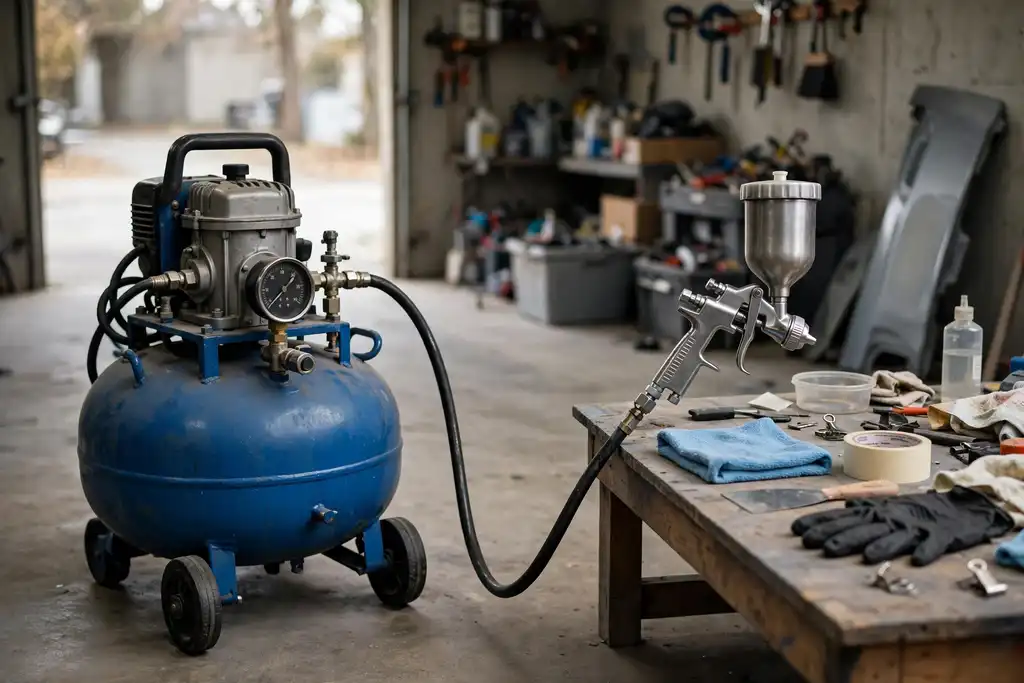
You need steady, clean air to lay down an even coat of paint without sputtering or uneven coverage. The best compressor for car painting for most home setups is the VEVOR Air Compressor, a 1 gallon unit with a 1HP oil-free motor running at 1700 r/min and 1.5 CFM at 90 PSI. Its 78 dB operation keeps the noise down while you work.
The VEVOR Air Compressor 1.2HP offers more output with a 2.1 gallon tank, 900W motor and 2.1 CFM at 90 PSI, which suits longer spray sessions. Here are the best compressor for car painting, with what each one does best.
Top Recommendation: VEVOR Air Compressor
Why We Recommend It: The VEVOR Air Compressor keeps things simple with its compact 1 gallon tank, 1HP oil-free motor, 1.5 CFM at 90 PSI and 78 dB quiet operation. It weighs 30.86 pounds and fits into tight spaces. The 1.2HP alternative offers more output, but the smaller unit covers light painting jobs with less bulk.
10 Best Compressor for Car Painting
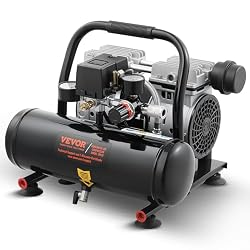




1. VEVOR Air Compressor 1 Gallon Steel Tank
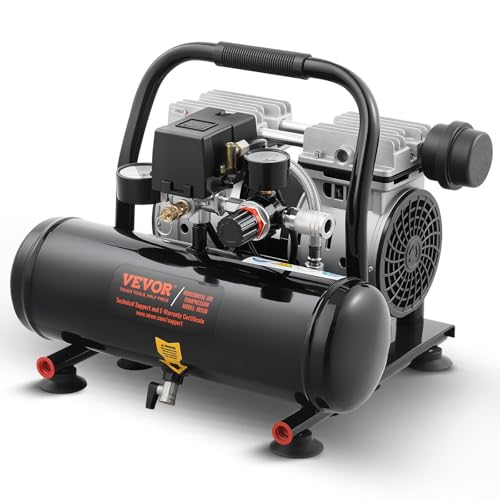
The VEVOR Air Compressor is a compact unit built around a 1 gallon steel tank and a 1HP oil-free motor. It runs up to 1700 r/min and delivers 1.5 CFM at 90PSI, with a maximum pressure of 120PSI. The oil-free design means you do not have to deal with oil changes or oil mist in your air line.
For painting work, the 1.5 CFM figure is the number that matters most. It suits small spray guns and touch-up work rather than full panel resprays. The 1 gallon tank refills quickly, so the motor cycles more often on longer jobs. If you are painting a bumper or a few small parts, that trade-off is usually fine.
Noise is one of the standout points here. VEVOR rates this compressor at 78 dB and fits it with a quality silencer made from a thickened muffler cover, a rubber muffler pipe and filter cotton. The same silencer also helps keep fine dust out of the motor. In a home garage, that quieter running makes longer sessions easier on you and your neighbours.
The tank is built from Q235B structural steel with a three-layer finish covering rust and wear resistance plus a plastic powder attachment layer. Seamless welding adds strength, and the tank is rated for large bearing pressure. The intake pipe uses high-temperature resistant silicone with stainless steel braided mesh for double protection against damage and corrosion.
Safety features are well covered for a compressor of this size. A large cooling fan works alongside automatic overheating protection to guard the motor. If current or stored pressure climbs too high, the unit shuts off automatically or releases pressure relief protection. It weighs around 30.86 pounds and measures roughly 14.8 by 13.6 by 13 inches, so it stores easily on a shelf.
This model suits hobbyists and home mechanics who need a portable compressor for touch-up painting, tire inflation and light pneumatic tool use. It handles nail guns, impact wrenches and spray guns within its airflow limits. If your painting projects are small and you value quiet operation, it is a sensible starting point.
2. VEVOR Air Compressor 2.1 Gallon 1.2HP 2.2
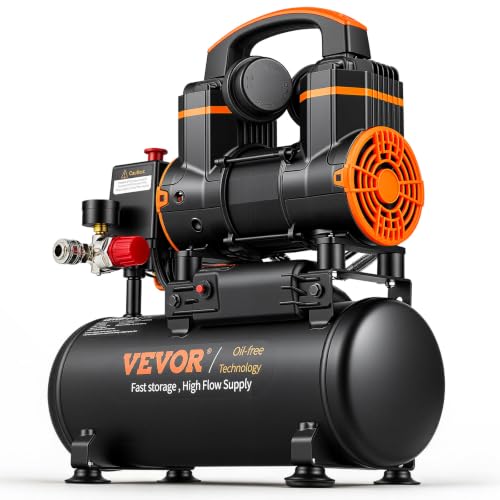
The VEVOR Air Compressor 1.2HP steps up the tank size to 2.1 gallons and the motor to 900W. It spins at 3500 r/min and pushes 2.2 CFM at 90PSI, with a maximum pressure of 116PSI. Like the smaller model, it is oil-free, so maintenance stays simple.
The higher 2.2 CFM output is the main reason to pick this one for painting. It can feed a spray gun with more consistent air than the 1 gallon model, and the larger tank gives the motor more headroom between refills. That combination makes it better suited to painting larger panels or working through a longer job without constant cycling.
Intake is handled by a double tube, double cylinder design that draws air through both cylinders at once. The intake pipe uses silicone rated to 392 degrees Fahrenheit plus stainless steel braided mesh for double protection. This setup is aimed at saving time and effort during inflation and continuous tool use.
Noise control gets two silencers rather than one. Each silencer combines a thickened muffler cover, a rubber muffler pipe and filter cotton, which reduces noise and keeps fine dust out of the motor. Two large cooling fans back up the automatic overheating protection, and the unit shuts off or relieves pressure if current or stored pressure gets too high.
The tank follows the same three-layer construction as the smaller model, with a rust and wear-resistant layer, a plastic powder attachment layer and Q235B structural steel. It is rated for 3.5 Mpa maximum bearing pressure, and seamless welding keeps the construction strong. At 27 pounds and roughly 17.7 by 6.5 by 18.5 inches, it is still easy to move around the garage.
This compressor suits people who paint more than the occasional small part and also want one machine for tire inflation, nailing and woodwork. The extra airflow and bigger tank make it the more capable choice for spray gun work. If your projects are growing beyond touch-ups, it is the stronger option of the two.
3. InoKraft Drizzle X Electric Spray Paint Gun
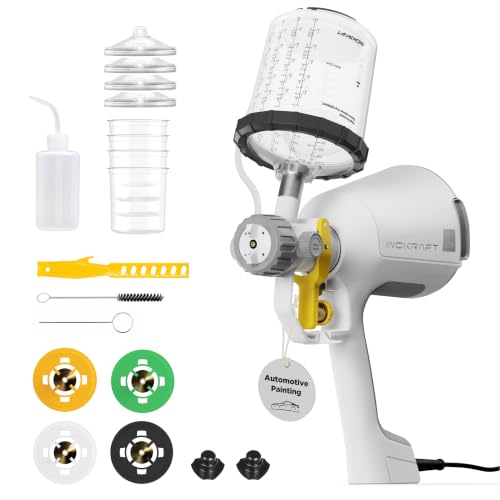
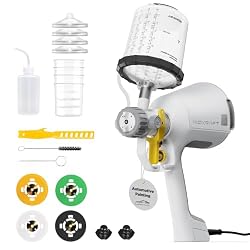
The InoKraft Drizzle X Electric is an 800W spray gun built for automotive spot refinishing. It runs without a separate air compressor or a heavy air hose, which keeps the setup simple for garage work. This makes it a practical option for hobbyists and small repair projects rather than full panel resprays.
It uses a pressurized gravity feed system to keep airflow and fluid flow consistent from the first drop to the last. A boost control helps support smoother atomization on small to medium refinishing jobs. The gun comes with four nozzle sizes, 1.0mm, 1.3mm, 1.5mm and 1.8mm, covering primer, clear coat and base coat work.
The adjustable spray pattern reaches up to roughly 250mm, so you can match it to flat panels, curved parts, edges and detail areas. That range suits spot repairs and touch up work more than large continuous surfaces. The 22 oz paint cup holds a useful amount for small jobs without constant refilling.
In the box you get the gun, a 22 oz cup, five disposable inner cups, a 16.4 ft power cord, a nozzle set, cleaning accessories and a user manual. The disposable cups cut down on cleanup time between coats and colours. The long cord gives you room to move around the car without hunting for an extension lead.
InoKraft backs the gun with responsive customer support for setup, troubleshooting, cleaning and replacement accessory questions. That matters for DIY users who may be new to spray painting and want guidance before and during a project. The unit is yellow and measures about 17.12 inches long by 13.7 inches wide by 5.11 inches high.
This gun suits garage hobbyists and DIY painters handling small to medium refinishing projects. It is less suited to someone planning full vehicle resprays or high volume shop work. For spot repairs and detail areas, it removes the cost and bulk of a compressor and hose setup.
4. VEVOR 2 HP Air Compressor 6.3 Gallon
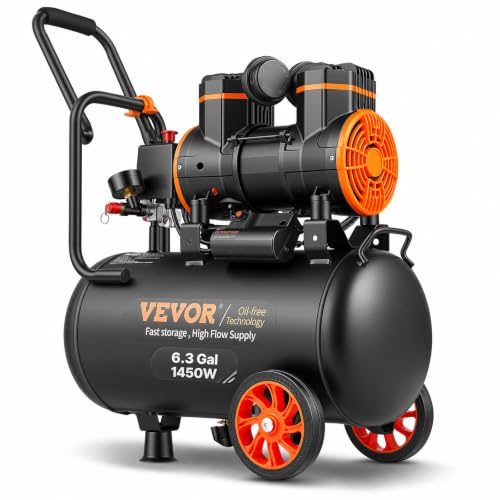
The VEVOR 2 HP Air is a 6.3 gallon oil free compressor with a 1450W motor that runs up to 3500 r/min. It delivers 3.35 CFM at 90 PSI and a maximum pressure of 116 PSI. That output supports a range of pneumatic and air tools, including spray guns, nail guns, impact wrenches and pneumatic screwdrivers.
The oil free design means no oil changes and less maintenance over the life of the unit. Double tube and double cylinder intake work together to save time and effort during inflation and tool use. The intake pipe uses 392 Fahrenheit high temperature resistant silicone with stainless steel braided mesh for double protection.
Noise reduction is handled by two silencers, each made up of a thickened muffler cover, a rubber muffler pipe and filter cotton. These reduce noise while also keeping fine dust out of the motor. For a garage or home workshop, that makes longer sessions easier on the ears and on neighbours.
The tank is built from a three layer process: a rust and wear resistant layer, a plastic powder attachment layer and Q235B structural steel. It handles a maximum bearing pressure of 3.5 Mpa and uses seamless welding construction. Two large cooling fans and automatic overheating protection guard against damage during heavy use.
Safety features go further than heat control. If the current or stored pressure gets too high, the compressor shuts off automatically or provides pressure relief protection. That gives peace of mind when the unit is running unattended between tasks. The whole unit weighs 43 pounds and measures 28.7 inches high, 25.2 inches long and 13 inches wide.
This compressor suits home mechanics and workshop users who want one machine for spray painting, tire inflation, auto repair and woodwork nailing. The 6.3 gallon tank is a sensible size for garage work without taking over the floor. Anyone after a quiet, oil free unit with solid safety protection should put it on the shortlist.
5. MZB Ultra Quiet Air Compressor 1.5HP 6.4
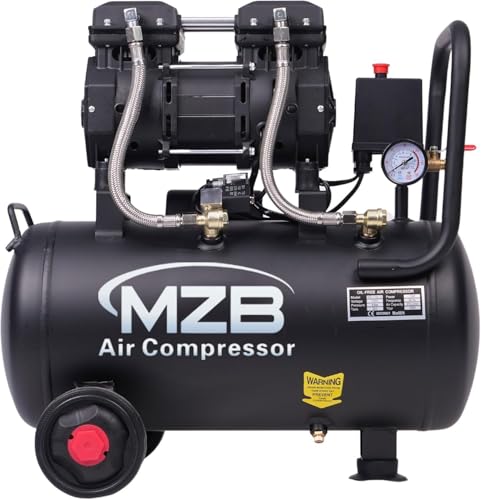
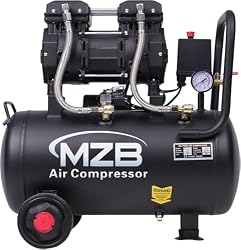
The MZB Ultra Quiet Air is a wheeled, oil-free compressor built around a 6.4 gallon steel tank. It runs on 110V at 60Hz with a 1.5HP motor and tops out at 115 PSI. The matte black unit measures 22 inches long, 22 inches high and 10 inches wide, so it rolls into a workshop corner without eating much floor space.
The headline figure here is the noise level of 70 decibels. Two professional silencers and thickened housing help keep the sound down, which matters if you paint in a garage near the house. The tank fills in about 60 seconds, so you spend less time waiting and more time with the gun in your hand.
Air delivery reaches 7.41 CFM at 115 PSI, with the motor spinning at 2880 r/min. That kind of output supports spray painting along with staple guns, brad nailers, roofing nailers and framing nailers. The steel tank holds enough reserve to keep the motor from cycling constantly during longer passes.
The oil-free motor avoids oil contamination in the air line, which is a real plus for paint work. The outer casing uses a three layer protective structure with an anti rust and wear resistant layer, a plastic powder coating and a Q235B structural layer. Maintenance is kept simple, so downtime and running costs stay low.
This is a good fit for a home painter or small shop that wants one machine for painting, auto repair and carpentry. It is compact and light enough to move between jobs. If quiet operation and steady CFM are your priorities, this one deserves a close look.
6. CRAFTSMAN Portable 12V Tire Inflator with Digital
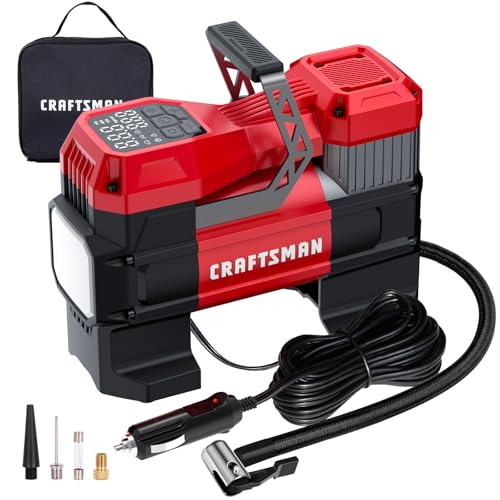
The CRAFTSMAN Portable 12V Tire is a compact inflator that plugs into a 12V car accessory socket. It delivers up to 150 PSI on its custom mode and weighs only 1.9 lbs. A 10 ft power cord and a 2.17 ft air hose give it enough reach around a vehicle.
Speed is the selling point. It can inflate a 195/65 R15 tire from 30 to 36 PSI in under a minute. That makes it a sensible backup for roadside emergencies or a quick check before a long drive.
The auto shut-off feature lets you set a target pressure in PSI, BAR or kg/cm squared, and the unit stops on its own to help prevent over-inflation. The LCD screen shows both current and target pressure at a glance. A built-in LED light with three modes helps when you are working at night.
It is not a painting compressor, and it should not be treated as one. There is no tank and no continuous CFM output for a spray gun. Its job is tires on cars and motorcycles, plus bikes and sports equipment thanks to the included adapters.
Everything stores neatly with built-in cord storage, a carry bag and a Presta valve adapter, inflatable adapter and ball needle. An extra fuse is included too. For a glovebox or trunk kit, this is a practical pick.
7. Timbertech Airbrush Kit with Compressor AS18-2K Basic
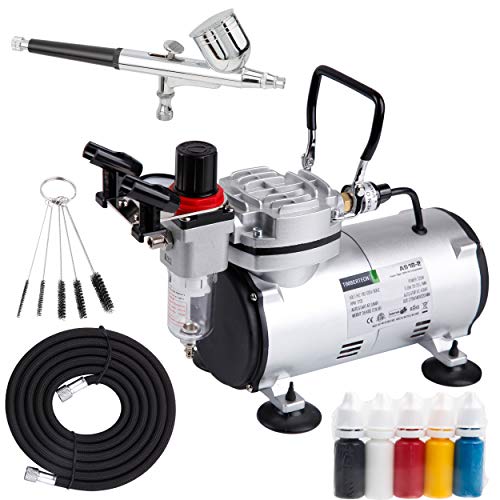
The Timbertech Airbrush Kit is a compact starter set built around an oil-less piston compressor. It comes with a built-in carry handle and weighs just under nine pounds, so it is easy to move between a workbench and a table. The kit includes a double-action gravity feed airbrush with a 0.30mm nozzle and needle, a 6ft air hose, a mini filter, cleaning brushes and five test paints.
The compressor runs quietly at around 47db, which makes it a good fit for indoor work where noise matters. Air flow is rated at 20 to 23 litres per minute, and the unit starts at 3 bar and stops at 4 bar automatically. There is a regulator with a gauge, a water trap and air filter, plus a pressure relief safety valve and an overheat protector.
This is a tool for detail rather than volume. The small nozzle and modest air flow suit fine lines, shading and controlled coverage on models, automotive graphics, temporary tattoos and craft painting. It is also used for nail art, cake decorating and spray tanning, where a gentle, precise spray matters more than a wide fan pattern.
One important limit is stated clearly by the maker: the compressor is only fit for airbrush work, not for a spray gun or other air tools. That means it is not a choice for laying down primer or clear coat on a full car panel. It is best understood as a hobby and detail kit, not a general purpose painting compressor.
The set suits designers, modellers, artists and decorators who want to start airbrushing without assembling separate parts. Because the hose, brush, filter and paints are included, a beginner can begin practising straight away. The maintenance free piston design also keeps setup simple, since there is no oil to top up.
For car related work, the Timbertech Airbrush Kit fits touch ups, graphics and small custom details rather than full panel resprays. Its quiet running and low weight make it comfortable to use for longer sessions at a desk. Anyone shopping for a compressor for car painting should treat this as a precision detail tool, not a substitute for a full size spray setup.
8. HVLP Air Spray Gun with 1.4/1.7/2mm Nozzles
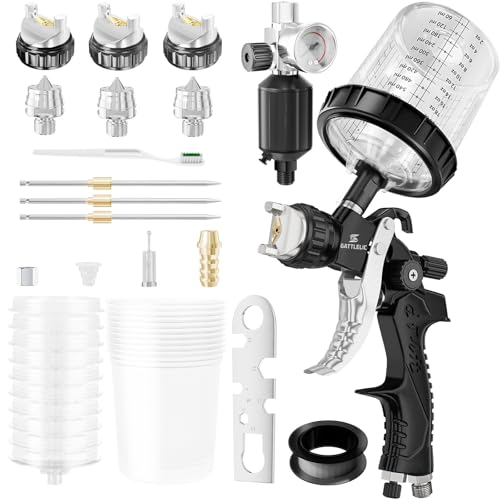
The HVLP Air Spray Gun is a gravity feed spray gun supplied with three nozzle sizes: 1.4mm, 1.7mm and 2.0mm. The 1.4mm nozzle comes already installed, and the other two are included for different coatings. It also ships with ten 600cc disposable mixing cups and lids, a brush, a wrench and sealing tape.
Working pressure is listed at 2.5 to 3.5 bar, with a spraying distance of 170 to 240mm and air consumption of 275 litres per minute. The paint capacity is 600cc and the spray width reaches 240mm. According to the maker, the HVLP design saves around 20 percent of paint and reaches a paint utilisation rate of up to 65 percent.
The cover is made of brass, and the 15-hole hood is precision machined to give a high atomisation effect. The gun lets you adjust the amount and amplitude of the spray, and the air conditioning valve gives further control over the pattern. A 1/4 inch NPT inlet connects the gun to the air line.
A useful inclusion is the 2-in-1 air compressor filter regulator. It has a reusable filter and lets you set and control air pressure at the gun, which is handy for automotive paint work. The regulator is described as heavy duty yet space saving, so it does not crowd the setup.
The three nozzles cover different jobs. The 1.4mm tip is intended for topcoats, the 1.7mm tip for primers, and the 2.0mm tip for larger area applications. The disposable cup system cuts waste of paint and cleaning solvents, and it removes the labour of cleaning reusable cups between coats.
The HVLP Air Spray Gun suits primers, clear coats and other high viscosity coatings, as well as topcoats and detail coats in automotive and furniture work. It is also used for house painting. It makes spraying softer and easier to control with less overspray, which helps when you are working on a car panel or a piece of furniture.
9. AEROPRO Tools R500 LVLP Air Spray Gun
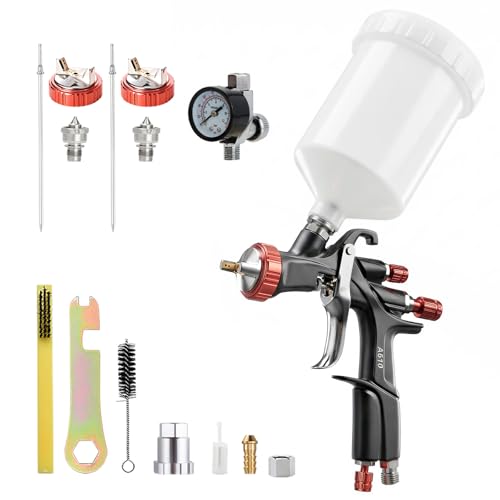
The AEROPRO Tools R500 LVLP is a gravity-feed air spray gun built for automotive painting and general coating work. It ships as a kit with three nozzle sizes, an air regulator and a 600 cc paint cup. The two-stage trigger gives you separate control over airflow and paint delivery, which helps when you are learning to lay down an even coat.
LVLP stands for low volume low pressure, and the numbers here are modest. Air consumption runs from 3.0 to 3.9 CFM at an operating pressure of 2.0 to 3.5 bar. That makes it a practical match for smaller compressors that would struggle to feed a full conventional gun. The trade-off is a slower application, so plan on steady passes rather than rushing.
The three nozzles cover most jobs you will meet. Use the 1.3 mm for low-viscosity basecoats and clearcoats, the 1.5 mm for medium-viscosity primers and top coats, and the 1.7 mm for high-viscosity or high-solids coatings. Matching the nozzle to the product is the single biggest factor in getting a smooth result. The manual walks through setup and operation step by step.
The body has a Teflon coating to resist paint buildup, and the nozzle and needle are stainless steel. That combination should hold up well with regular cleaning between coats. The included air regulator lets you dial in pressure at the gun rather than guessing at the tank. A clean gun with the right pressure is what separates a decent finish from a rough one.
Beyond cars, this gun handles furniture, cabinets, varnish and top coats, so it earns its place in a general workshop. The 600 cc cup is a sensible size for panel work and smaller projects. If you already own a compressor in the 3 to 4 CFM range, this is a logical pairing. Just keep your fluid mixes within the viscosity ranges the nozzles are designed for.
10. ROCGORLD R8 Tire Inflator Portable Air Compressor
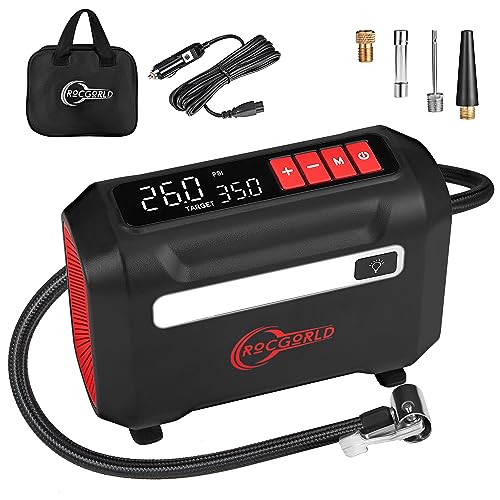
The ROCGORLD R8 Tire Inflator is a portable 12V air compressor aimed at tires, bikes, balls and other inflatables. It is compact at roughly 2.79 by 4.92 by 6.49 inches and weighs about 2.16 pounds. A carrying bag is included, so it stows neatly in a trunk or under a seat.
Speed is the headline here. The 40 L/min cylinder can inflate a 215/50 R17 tire from 26 to 35 PSI in under a minute. It can also bring a 235/40 R19 Tesla tire from 28 to 36 PSI in about 1.5 minutes. For a 12V unit, that is quick work on a roadside top-up.
The dual digital LED display shows real-time pressure, your preset value, product status and any errors. An advanced chip handles pressure control and monitoring, so you are not squinting at a analog gauge. Preset your target, press start, and the auto-shutoff stops inflation at the right point. A memory function recalls your last setting for one-key use next time.
Operation takes three steps: connect, preset and start. That simplicity makes it usable even if you have never touched a tire inflator before. It also doubles as an emergency light with three modes for nighttime work. The 10FT power cord and 2FT hose are made from materials that resist damage from folding and bending.
Note that this unit has no battery and cannot run from an AC wall plug. It needs a 12V DC supply rated 10 to 15 amps, so use the included cable and keep it away from heat, oil and sharp objects. The box includes the inflator, carrying bag, Schrader-Presta valve, fuse, needle valve and extension. A two-year warranty backs it up. This is a sensible pick for anyone who wants fast, accurate inflation without hauling out a full workshop compressor.
Our Testing Process: Why These Rankings Are Different
The goal here is simple. We want to look past the marketing claims and focus on what actually matters when you choose a compressor for car painting. Buyers deserve clear information about real performance instead of glossy promises.
Our evaluation draws on specifications, materials and build quality, patterns in owner feedback, brand reputation and overall value. We weighed which of these factors mattered most for painting tasks and let that shape the rankings. The VEVOR Air Compressor and the VEVOR Air Compressor 1.2HP are good examples of products that stood out once those factors were weighed together.
We compared products across a wide price range, from budget-friendly units to more expensive options. A higher price does not automatically mean a better result, and some costlier models gave up ground on the factors that count most. The VEVOR Air Compressor 1.2HP is one case where the value stood out relative to the field.
The aim is trustworthy, data-driven guidance you can rely on. This is research and evaluation, not hands-on testing, so we make no claims about personal use. Every ranking reflects the evidence available, presented plainly so you can decide with confidence.
Complete Buyer’s Guide: How to Choose Compressor for Car Painting
Understanding What a Compressor Must Deliver for Painting
Car painting is not the same job as inflating tyres or running a nail gun. A spray gun needs a steady supply of clean, dry air at a consistent pressure, and any drop in that supply shows up as uneven coverage or a mottled finish. The compressor has to match the gun’s air demand, not just its pressure rating, or the whole job suffers.
Key Features to Look For
Start with CFM at the pressure your gun will actually run at, because tank size alone tells you very little. Look for a tank that smooths out the pulses, a regulator you can trust, and a moisture filter or trap to keep water out of the line. Add a duty cycle figure and a noise rating, since painting sessions can run long and loud units wear you down.
Types of Compressor Compared
Small direct drive units like the VEVOR Air Compressor 1.2HP and the VEVOR 2 HP Air are cheap and portable but limited in sustained output. Quiet, oil free models such as the MZB Ultra Quiet Air and the InoKraft Drizzle X Electric suit home garages where noise matters. For serious spraying, a larger tank and higher CFM matter more than a fancy badge on the case.
How to Use a Compressor for Best Results
Set the regulator to the gun’s recommended inlet pressure while the gun is flowing, not while it sits idle. Drain the tank before each session and keep a water trap close to the gun, and check the air hose bore so it does not choke the flow. Practise on scrap panels first so you can dial in spray pattern and speed before touching the car.
What to Avoid
Avoid buying on tank size alone, because a big tank with a weak pump still runs out of air mid panel. Do not skip filtration, as moisture and oil ruin a finish faster than almost anything else. Also avoid long, narrow hoses and cheap regulators, which cause pressure drop and make consistent atomisation almost impossible.
Matching a Compressor to Your Workshop and Gun
Check the air consumption of your spray gun first, then pick a compressor that comfortably exceeds it. A small touch up gun or the Timbertech Airbrush Kit runs fine on a compact unit, while an HVLP Air Spray Gun or the AEROPRO Tools R500 LVLP needs more sustained CFM . Space, noise and power supply all shape the choice as much as the spec sheet.
When to Expect Results and How to Maintain a Compressor
You should see a consistent finish once pressure, filtration and gun settings are dialled in, usually after a few test panels. Maintain the unit by draining the tank after every use, checking the oil level on lubricated models and cleaning or replacing the air filter regularly. Store hoses coiled and dry, and inspect the regulator and fittings for leaks before each session.
Best Compressor for Car Painting FAQs
Are There Any Compressor for Car Painting Features I Should Look For?
Look for a built-in regulator and a good pressure gauge. Fine control at the gun is what gives you an even coat. A water trap or filter is also worth having, either on the unit or in the line.
Check the duty cycle, which tells you how long the motor can run before it needs to cool. For painting, a higher duty cycle means fewer pauses and steadier air. Tank size and drain valve placement are practical details that matter day to day.
Noise level is easy to overlook until you are working in a small garage. Consider the footprint and weight if you need to move the unit around. Good fittings and a solid hose connection save you leaks later.
Are There Any Tips for Using a Compressor for Car Painting?
Start with clean, dry air. Fit a filter and a water trap close to the gun, because moisture in the line causes tiny blisters in the paint. Drain the tank before every session and check the trap as you go.
Set the pressure with the gun trigger pulled and air flowing, not static. That gives you the true working pressure at the nozzle. Then keep the gun moving at a steady speed and overlap each pass by about half.
Clean the gun straight after use, and flush the line if you can. Store the compressor with the tank drained to slow corrosion inside. Small habits like these make a big difference to the finish.
Can I Use a Small Compressor for Car Painting?
You can, but only within limits. Small compressors often struggle to feed a full-size spray gun continuously, so the pressure drops mid-panel. That leads to uneven coverage and a dry, textured finish.
A better route with a small unit is a touch-up or detail gun, which uses far less air. Work in small sections and let the compressor recover between passes. Keep the tank topped up and check the gauge before each coat.
If you plan to paint whole panels or a full car, a small compressor will slow you down and frustrate you. For spot repairs and small parts it can do a decent job. Match the tool to the compressor and you will get better results.
For Car Painting, is It Better to Use a Larger Tank or Higher CFM on a Compressor for Car Painting?
CFM keeps the gun fed, while the tank smooths out the supply. A high CFM pump with a modest tank will usually outperform a big tank with a weak pump. The gun needs a steady flow, not just stored air.
A large tank helps with long passes and reduces motor cycling, which keeps things cooler and quieter. But if the pump cannot refill fast enough, the tank empties and the pressure falls. So CFM comes first, tank second.
For most car painting, aim for a compressor that meets your gun’s CFM with headroom, then pick the largest tank you can fit and afford. That combination gives you the steadiest results. Do not trade airflow for tank size.
How Do I Avoid Moisture Problems with a Compressor for Car Painting?
Moisture comes from air being compressed and heated, then cooling in the line. Fit a water trap and a filter as close to the gun as practical. Drain the tank at the start and end of every session.
A longer hose run gives moisture more chance to condense before it reaches the gun. Keep the compressor in a cooler spot if you can, and avoid long pauses with a full, hot tank. Check the trap often and empty it before it fills.
If you still see water spots, add a second trap or a desiccant filter at the gun. Keep the tank valve cracked open when the unit is stored. Dry air is the single biggest factor in a clean finish.
How Long Can I Run a Compressor for Car Painting Before It Needs a Rest?
That depends on the duty cycle, which is the share of time the motor can run in a given period. A 50 percent duty cycle means ten minutes on, ten minutes off, roughly. Check the manual for your unit’s figure.
Painting often means long, steady air use, so a low duty cycle unit will overheat and cut out. Give the motor time to cool between panels and watch for a hot pump or a pressure drop. Never ignore the cut-out, it is protecting the motor.
If you paint often, choose a compressor with a higher duty cycle or a continuous rating. That lets you work without constant pauses. For occasional small jobs, a hobby unit with rest breaks is fine.
What Are the Best Compressors for Car Painting?
The best one for you depends on your gun and your workload. Look for a unit that delivers enough CFM at your working pressure with a little to spare. Reliability and steady output matter more than a fancy label.
Oil-lubricated pumps tend to run cooler and last longer under long sessions. Direct drive units are cheaper and lighter but noisier and less suited to constant use. Think about how often you will paint before you choose.
Also check the tank size, the pressure regulator and the duty cycle. A compressor that can run continuously suits full panels, while a hobby unit is fine for small jobs. Buy for the work you actually do, not the work you imagine.
What Size Compressor for Car Painting Do I Need?
Size comes down to airflow, not tank volume. A typical spray gun needs a steady supply of air, so check the CFM figure on the gun and match it to the compressor’s output at the same pressure. A small tank can work if the pump keeps up, but a bigger tank gives you steadier pressure.
Look at the CFM rating at the pressure your gun runs at, usually around 30 to 45 psi for many jobs. If the compressor’s CFM is lower than the gun’s demand, the gun will starve and the finish will sputter. Always leave a little headroom between the two figures.
Tank size affects how often the motor cycles, not the quality of the spray. A larger tank helps with longer continuous passes and keeps the pump cooler.
Final Verdict
Portability and power output separated the top contenders. Based on our research and data analysis, the InoKraft Drizzle X Electric suits painters who need consistent spray pressure and quiet workshop runs. For quick inflation away from the garage, the CRAFTSMAN Portable 12V Tire delivers cordless convenience and compact storage without fuss. Each serves a different need well, so match your setup to the job at hand.